

Reviewed by Jose Joseph CFP®, founder of EBlink and a practising employee benefits consultant.
A clear employee benefits renewal timeline is the difference between a renewal that lands calmly and one that turns into a last-minute scramble. For South African brokers, every employer group carries several renewals at once: group risk, medical aid, gap cover and the retirement fund, often on different dates and with different insurers.
This guide sets out a practical 120-day renewal timeline you can use for every employer group. It covers what to do at each stage, who should own it, and how to keep the whole process visible across your practice.
Why an Employee Benefits Renewal Timeline Matters
Most renewal problems are not caused by bad advice. They are caused by time running out.
When a renewal date arrives without a review, the broker has few options. The employer either accepts the insurer’s renewal terms as they are, or the broker rushes a market check that nobody has had time to think about. Neither builds trust.
A written renewal timeline fixes this in three ways:
- It starts the work early enough for a proper review and, where needed, a market check.
- It gives every person in the practice the same picture of what is due next.
- It creates a record of what was done and when, which supports your FAIS obligations and your relationship with the employer.
If you are still building your overall approach, our guide to the employee benefits renewal process covers the steps in more detail. This article focuses on timing.
The 120-Day Employee Benefits Renewal Timeline at a Glance
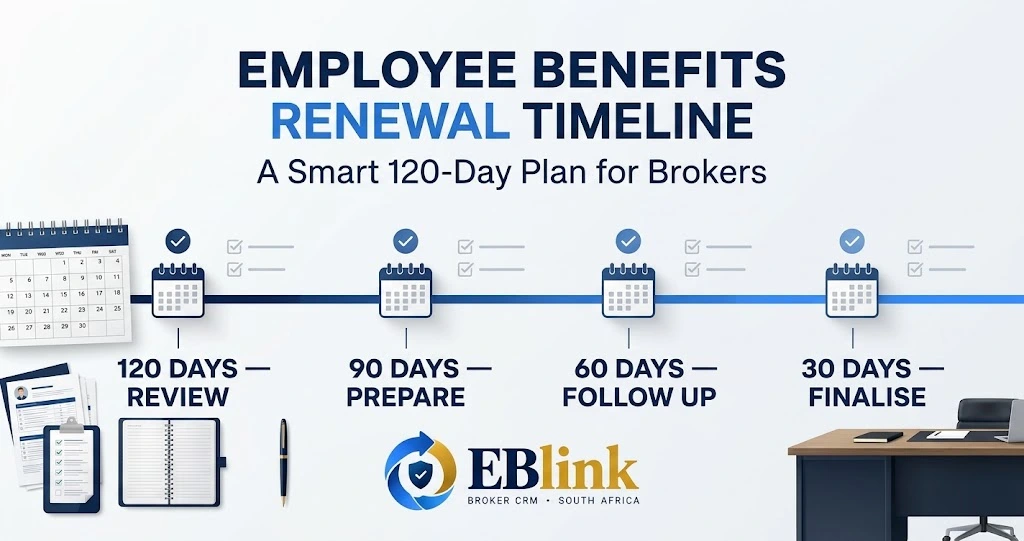
Here is the full timeline in one view. Each stage is explained below.
- 120 days out: confirm the renewal date, gather claims and membership data, and diarise every milestone.
- 90 days out: hold the pre-renewal review with the employer and agree on priorities.
- 75 days out: request renewal terms and, if agreed, approach the market.
- 60 days out: analyse terms and quotes, and prepare your recommendation.
- 45 days out: present the recommendation to the employer and document the advice.
- 30 days out: confirm the decision in writing and instruct the insurer.
- 0 to 14 days after: confirm new terms are live, update records and communicate with members.
Adjust the numbers to suit the size of the group. A 20-member group might move faster than a 2,000-member scheme, but the order of the steps stays the same.
120 Days Out: Set Up the Renewal
The first stage is about making sure nothing surprises you later.
Start by confirming the exact renewal date for every product the employer holds. It is common for group life, disability and funeral cover to renew together while medical aid follows the calendar year and gap cover has its own date.
Next, collect the information you will need:
- Current membership numbers and salary data
- Claims experience for the past one to three years
- Any changes the employer has made or is planning, such as restructuring or new sites
- Open service issues and complaints from members
Finally, put every milestone from this timeline into your diary or CRM against the employer record. In EBlink, each policy carries its renewal date and sits in a renewal pipeline ordered by what is due next, so the 120-day mark appears automatically instead of relying on memory.
90 Days Out: Hold the Pre-Renewal Review
The pre-renewal review is the most valuable conversation in the whole renewal timeline.
Meet the employer’s HR or finance contact before any terms arrive. Ask what has changed in the business, what employees have said about their benefits, and what the employer wants from this renewal. Some want to contain cost. Others want to improve cover to help with recruitment.
Agree on clear priorities and record them. Our client review checklist is a useful structure for this meeting, and good meeting preparation makes it far more productive.
By the end of this stage you should know whether the employer expects a full market check or a review of the existing terms only.
75 Days Out: Request Terms and Approach the Market
Now ask the current insurers for renewal terms. Insurers usually need time to underwrite, especially for larger groups or where claims experience has been poor.
If the employer has agreed to a market check, send the same complete data pack to each insurer you approach. Incomplete data is the most common reason quotes arrive late or with conditions attached.
Keep a log of every request, who you sent it to and when you expect a response. Our guide to broker insurer management covers how to keep provider correspondence organised so follow-ups do not slip.
60 Days Out: Analyse Terms and Prepare Your Recommendation
With renewal terms and any quotes in hand, compare them on a like-for-like basis. Look beyond the headline premium:
- Benefit levels and definitions, especially for disability cover
- Free cover limits and any underwriting requirements
- Exclusions, waiting periods and continuation options
- Service standards and claims experience with each insurer
- The total cost to the employer and, where relevant, to employees
Write down the reasons behind your recommendation as you go. This becomes the basis of your record of advice and protects both you and the employer if the decision is questioned later.
45 Days Out: Present and Document the Advice
Present your findings to the employer in plain language. Explain what changes, what stays the same and why you recommend a particular option.
Give the employer time to consult internally. Larger employers may need a board or committee decision, so build that into the renewal timeline from the start.
Record the meeting, the options presented and the questions raised. Clear notes make the next renewal easier, because you will know exactly what the employer cared about last time.
30 Days Out: Confirm the Decision and Instruct the Insurer
Get the employer’s decision in writing. Then instruct the insurer to accept the renewal terms or to implement the new cover.
Confirm the effective date, the premium, any changes to benefits and any new member requirements. If cover is moving to a new insurer, check that there is no gap in cover between the old and new policies.
This is also the time to plan member communication. Employees need to know what is changing, especially if benefits or contributions are different.
After the Renewal: Close the Loop
A renewal is not finished when the insurer confirms the terms. In the two weeks after the effective date:
- Confirm the new schedule and premium are correct
- Update the employer record, policy details and next renewal date
- Send members a clear summary of their benefits
- Note anything that went wrong so you can improve the next renewal timeline
Then set the next renewal’s 120-day milestone straight away.
Common Reasons Renewal Timelines Slip
Even well-run practices lose time on renewals. The usual causes are:
- Renewal dates kept in spreadsheets that nobody checks until it is too late. Our article on why brokers are moving away from spreadsheets explains the risk.
- Incomplete data packs that send insurers back with questions.
- No single owner, so each consultant assumes someone else is following up.
- Late employer decisions because the review meeting happened too close to the renewal date.
- No record of last year’s renewal, so every renewal starts from scratch.
Each of these is a timing problem, and each is solved by starting earlier and making the renewal timeline visible.
How to Manage Many Renewal Timelines at Once
A single renewal is easy to manage. Fifty overlapping renewals across group risk, medical aid and retirement funds are not.
This is where a structured system helps. A good employee benefits CRM should let you:
- See every renewal in the next 90 days in one list, with its stage and value
- Move each renewal through clear stages, such as upcoming, in progress, confirmed or not renewing
- Record every insurer and employer follow-up against the client
- Give principals a view of the whole practice and consultants a view of their own clients
EBlink was built by a practising employee benefits consultant to do exactly this. You can see how the renewal pipeline works on our features page or compare plans and pricing.
Adjusting the Renewal Timeline by Product Type
Not every product follows the same rhythm. Use the 120-day timeline as the base and adjust for each product.
Group risk (life, disability and funeral cover)
Group risk renewals usually depend on claims experience and membership changes. Larger groups with experience-rated pricing need more time, because insurers underwrite the whole scheme. Start at 120 days and allow extra time if disability claims have risen. Our renewal tracking guide covers how to keep these dates visible across every employer group.
Medical aid
Medical schemes generally announce new contribution increases and benefit changes in the second half of the year, ahead of a 1 January renewal for most employer groups. That compresses the timeline into a few weeks. Plan your employer and member communication in advance so you are ready to move quickly once the new options are published. The Council for Medical Schemes publishes industry information that can help you prepare.
Gap cover
Gap cover often renews on its own anniversary date, separate from the medical scheme. Diarise it separately so it is not forgotten when the medical aid renewal is complete.
Retirement funds
Retirement fund reviews tend to follow the fund’s financial year and the employer’s budget cycle. They are less about a single renewal date and more about regular reviews of investment choices, costs and member communication. Build an annual review date into the same system so it sits next to the employer’s other renewals.
Who Owns Each Stage?
A renewal timeline only works if everyone knows their part. In a small practice one person may do everything. In a larger team, split it clearly:
- Principal or key individual: signs off the recommendation and reviews high-value renewals.
- Consultant: owns the employer relationship, runs the pre-renewal review and presents the advice.
- Administrator: gathers data, requests terms, chases insurers and updates records.
Record the owner of each renewal against the employer, so that if someone is on leave, the next person can see exactly where things stand. This is also what makes a smooth client handover possible when an adviser leaves.
Communicating With the Employer Through the Renewal
Employers value a broker who keeps them informed without being asked. Build simple touchpoints into the renewal timeline:
- At 120 days, let the employer know the renewal process has started and when you will meet.
- After the pre-renewal review, send a short summary of what was agreed.
- When terms arrive, tell the employer when they can expect your recommendation.
- After the decision, confirm the next steps and the effective date.
Our guide to client communication has more ideas for keeping employers informed throughout the year.
Employee Benefits Renewal Timeline FAQs
How early should a broker start an employee benefits renewal?
Around 120 days before the renewal date is a sensible default. Smaller groups with stable claims can start later, but starting early gives you time for a proper review and a market check if one is needed.
What if the insurer sends renewal terms late?
Log the date you requested terms and follow up in writing. Keep the employer informed so they understand the delay is not on your side, and prepare as much of the analysis as you can in advance.
Should every renewal include a market check?
Not necessarily. Agree on the approach with the employer at the pre-renewal review. Some years a review of the existing terms is enough, while other years a full market check is the right call.
Renewal Timeline Checklist
Use this as a quick reference for every employer group:
- Renewal dates confirmed for every product
- Claims and membership data collected
- Pre-renewal review held and priorities recorded
- Renewal terms requested and market approached if agreed
- Like-for-like comparison completed
- Recommendation presented and advice documented
- Decision confirmed in writing and insurer instructed
- Members informed and records updated
- Next renewal timeline set
Final Thoughts
A predictable employee benefits renewal timeline protects your relationships, your revenue and your compliance record. Start at 120 days, give every stage an owner, and keep it all in one place.
If you would like to see your own renewals in a live pipeline, start a free 30-day trial of EBlink and import your book from a spreadsheet in an afternoon. Need help moving your data? Our broker CRM onboarding team can map it with you.