

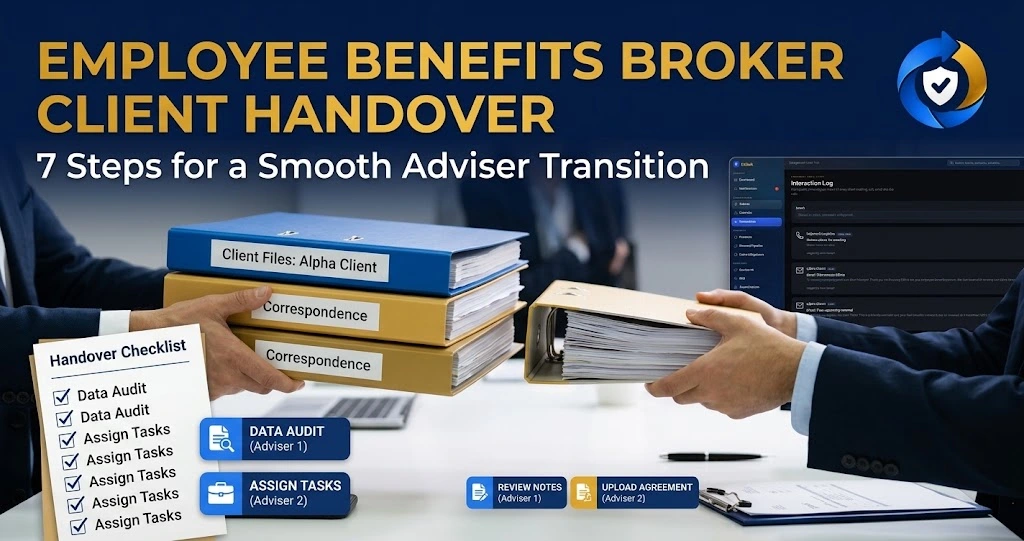
Employee Benefits Broker Client Handover: 7 Steps. A smooth employee benefits broker client handover helps South African brokerages maintain consistent service when an adviser leaves, responsibilities change or a client account is transferred to another team member.
Employee-benefits relationships often involve employer contacts, scheme information, product details, renewal dates, ongoing requests and important communication records. If these details are scattered across emails, spreadsheets and personal notes, the incoming adviser may struggle to understand the client’s needs and identify what requires attention.
A structured handover helps reduce confusion, protect continuity and give the next person a clearer picture of the account.
Here are seven practical steps employee-benefits brokers can use to improve client handovers.
1. Prepare a complete client profile
Start by reviewing the information the incoming adviser will need to understand the client relationship.
Depending on the account, this may include:
- Employer and organisation details
- Key decision-makers and authorised contacts
- Relevant employee-benefit arrangements
- Products and service providers associated with the account
- Important communication preferences
- Upcoming reviews, renewal dates and agreed actions
Check that the information is accurate and up to date. Where details are missing or uncertain, flag them for verification rather than treating assumptions as confirmed facts.
A well-maintained client profile gives the incoming adviser a useful starting point without requiring them to reconstruct the entire relationship from old emails.
2. Document the current client relationship
A handover should explain more than who the client is. It should also help the incoming adviser understand the relationship.
Record relevant information about recent meetings, client priorities, outstanding concerns and agreed next steps. Include important decisions and commitments that may affect future service.
For example, an employer may be waiting for an update, preparing for a benefits review or expecting a response following a recent discussion.
Document these details factually and professionally. Avoid personal opinions or unnecessary sensitive information.
A clear relationship summary helps the next adviser continue the conversation without repeatedly asking the employer to explain matters that have already been discussed.
3. List all outstanding tasks and requests
One of the most important parts of an employee benefits broker client handover is identifying work that has not yet been completed.
Create a clear list of open items, including:
- Outstanding client queries
- Documents or information still required
- Requests awaiting a provider’s response
- Actions promised to the employer
- Administrative tasks requiring follow-up
- Issues that need escalation
For every item, record its current status, the next action, the responsible person and the relevant deadline where applicable.
Avoid vague descriptions such as “follow up with client.” Instead, explain what needs to happen and what information is still required.
This gives the incoming adviser a practical action list and reduces the risk of tasks being overlooked during the transition.
4. Highlight upcoming renewals and important dates
A change in account responsibility should not cause important dates to disappear from view.
Review the client’s upcoming renewal milestones, scheduled reviews, outstanding submissions and other relevant deadlines. Include enough context for the incoming adviser to understand what needs preparation and when action should begin.
Where dates depend on a provider, policy, scheme or client agreement, verify them against the appropriate records.
Do not rely exclusively on someone’s memory or a calendar entry without supporting context.
An organised schedule helps the incoming adviser prioritise work and plan communication with the employer before important milestones arrive.
5. Organise correspondence and supporting documents
Important information can be difficult to transfer when correspondence is spread across personal inboxes, shared drives and separate spreadsheets.
Bring relevant records together in approved, access-controlled business systems. Organise documents and communication history so that the incoming adviser can locate information without unnecessary searching.
The handover may reference:
- Important emails and meeting notes
- Relevant client instructions
- Outstanding correspondence
- Provider responses and supporting documents
- Records of agreed actions
- Documents needed for upcoming reviews
Use your brokerage’s approved procedures for handling personal and confidential information. Transfer only information needed for legitimate business purposes, and ensure access is restricted to authorised people.
For South African brokerages, information handling should be considered in line with applicable privacy obligations, including the Protection of Personal Information Act (POPIA). Consult the relevant official guidance and your compliance procedures where necessary.
6. Introduce the incoming adviser to the client
A well-documented handover is important, but the human side of the transition matters too.
Where appropriate, inform the employer or relevant contact about the change in responsibility. Explain who the new contact person is, when the change takes effect and how the client can reach the right person.
A suitable introduction should be clear, professional and reassuring. Avoid making promises about service or response times that the brokerage cannot guarantee.
For complex accounts, consider arranging a joint meeting or introduction between the outgoing and incoming advisers. This gives the client an opportunity to raise current concerns and helps the new adviser understand the relationship directly.
Clear communication can help maintain confidence during a change in personnel.
7. Confirm that the handover is complete
Do not treat the handover as finished simply because the records have been sent.
Use a checklist to confirm that the incoming adviser has received the necessary information, understands the outstanding work and knows which actions require immediate attention.
A practical final review should confirm that:
- The client profile has been checked.
- Key contacts and relationship notes are available.
- Open tasks have assigned owners.
- Upcoming deadlines and renewals are visible.
- Relevant documents and correspondence are accessible.
- The client communication plan has been agreed.
- Access permissions and responsibilities have been reviewed.
Record any remaining gaps and assign follow-up actions. This creates a clearer record of the transition and helps the brokerage identify where its handover process can improve.
How a broker CRM can support client handovers
A consistent handover process is easier to maintain when client information and day-to-day activities are organised in a central business system.
A broker CRM can help a brokerage maintain client and contact records, review interaction history, track renewal activity and identify outstanding actions, depending on the system’s available features and how the team uses it.
EBlink is a broker CRM designed for South African employee-benefits brokers. Explore the EBlink website to learn more about organising broker-practice information.
You can also review the available EBlink CRM features and pricing information to assess whether the platform fits your brokerage’s workflow.
The goal is not simply to transfer files. It is to make relevant information easier for authorised team members to find, understand and act on.
Final thoughts
An effective employee benefits broker client handover protects continuity by ensuring that client records, relationship context, outstanding tasks and important dates are not lost when responsibilities change.
By preparing a complete profile, documenting the relationship, assigning open actions, highlighting deadlines, organising correspondence, communicating with the client and confirming completion, South African brokerages can make account transitions more structured and manageable.
Review your current process and identify where information is most likely to be missed. A repeatable checklist and well-organised client records can make the next handover easier for both your team and your clients.
Want to organise your employee-benefits brokerage more effectively? Visit EBlink to explore a CRM designed for South African employee-benefits brokers.
follow our socials:
Instagram
Facebook