

Employee Benefits Compliance South Africa: 6 Smart Tips for Brokers. Employee benefits compliance South Africa is an important consideration for brokers managing clients, products, renewals, records and ongoing professional obligations.
For a growing employee benefits practice, compliance-related work can quickly become difficult to manage when information is spread across spreadsheets, emails, calendars and separate folders.
The challenge is not always knowing what needs to be done.
The challenge can be keeping the right information visible, organised and accessible when it is needed.
In this article, we look at 6 practical ways South African employee benefits brokers can create a more organised approach to compliance and practice management.
TABLE OF CONTENTS
- Keep compliance information organised
- Track important dates and obligations
- Keep CPD information visible
- Connect compliance with client information
- Give your team better visibility
- Review your compliance process regularly
- How EBlink supports organised compliance
- Important note about compliance software
- Final thoughts
1. Keep Compliance Information Organised
A good employee benefits compliance South Africa process starts with organisation.
Brokers may need to manage information relating to clients, representatives, professional development, obligations, renewals and other practice activities.
When this information is stored in different places, it can be difficult to know whether the latest information is available.
A spreadsheet may contain one set of dates.
An email inbox may contain another set of reminders.
A shared folder may contain supporting documents.
A personal calendar may contain another important deadline.
The more places your team uses, the harder it becomes to maintain a clear picture of what requires attention.
A central practice management system can help bring relevant information into one environment.
The objective is simple: make important information easier to find, review and manage.
2. Track Important Dates and Obligations
Dates are a major part of compliance and practice management.
A brokerage may need to keep track of renewal dates, client obligations, follow-ups, professional development activities and other deadlines relevant to its operations.
Missing an important date can create unnecessary pressure for a team.
Instead of relying entirely on memory, email reminders or separate spreadsheets, brokers can use a structured system to make important obligations more visible.
A useful process should make it easier to answer questions such as:
- What needs attention?
- Who is responsible?
- When is it due?
- What has already been completed?
- What is overdue?
- What needs to happen next?
The purpose of tracking is not simply to create another list.
It is to give the brokerage a clearer view of work that needs attention.
3. Keep CPD Information Visible
Continuous Professional Development, or CPD, is part of the fit-and-proper framework administered by the Financial Sector Conduct Authority for relevant financial services providers, key individuals and representatives.
For South African brokers, keeping professional development information organised is therefore an important part of practice administration.
The FSCA provides information on CPD as part of its fit-and-proper requirements.
Rather than keeping professional development information in isolated notes or spreadsheets, brokers can benefit from having a consistent process for recording and reviewing relevant activities.
The practical questions are straightforward:
- What activities have been completed?
- What information needs to be recorded?
- What still requires attention?
- Where can the relevant information be found?
A structured system can make these questions easier to answer.
It is important to remember that software does not replace the broker’s or FSP’s regulatory responsibilities.
It simply provides a more organised way to manage the information and activities associated with those responsibilities.
4. Connect Compliance With Client Information
Compliance work does not always happen separately from client work.
Employee benefits brokers manage client relationships, products, interactions, renewals and other activities at the same time.
That means important practice information can be easier to manage when it is connected.
For example, a broker may need to review a client relationship while also checking upcoming obligations or renewal activity.
If the relevant information is stored in separate systems, moving between them can slow down the process.
A central CRM can provide a clearer connection between clients and the activities surrounding those clients.
This can help brokers understand the wider context instead of looking at individual tasks in isolation.
For a growing employee benefits practice, this type of visibility can become increasingly valuable.
5. Give Your Team Better Visibility
Employee benefits compliance South Africa is not only an individual responsibility.
In a growing brokerage, several people may be involved in managing clients, administration, compliance-related activities and practice operations.
If important information exists only in one person’s spreadsheet or inbox, other team members may struggle to understand what is happening.
A shared practice environment can give authorised team members better visibility.
For example, a team member should be able to see relevant client information, upcoming activities and outstanding items without relying entirely on another person’s personal notes.
This can also help when responsibilities change or someone is unavailable.
The goal is not to give everyone access to everything.
The goal is to create an organised environment where the right people can access the information they need to perform their responsibilities.
6. Review Your Compliance Process Regularly
Technology can help organise information, but the process behind the technology is equally important.
Take time to review how your brokerage currently handles compliance-related administration.
Ask yourself:
- Where do we record important obligations?
- How do we track upcoming deadlines?
- How do we manage CPD information?
- Where are supporting records stored?
- Can another team member understand the status of an outstanding item?
- How do we identify overdue activities?
- How much of this process still depends on spreadsheets?
- Are important reminders dependent on individual team members?
These questions can highlight areas where your current process may benefit from better organisation.
A regular review can also help your team identify unnecessary duplication.
If the same information is being entered into several systems, there may be an opportunity to simplify the workflow.
How EBlink Supports Organised Compliance
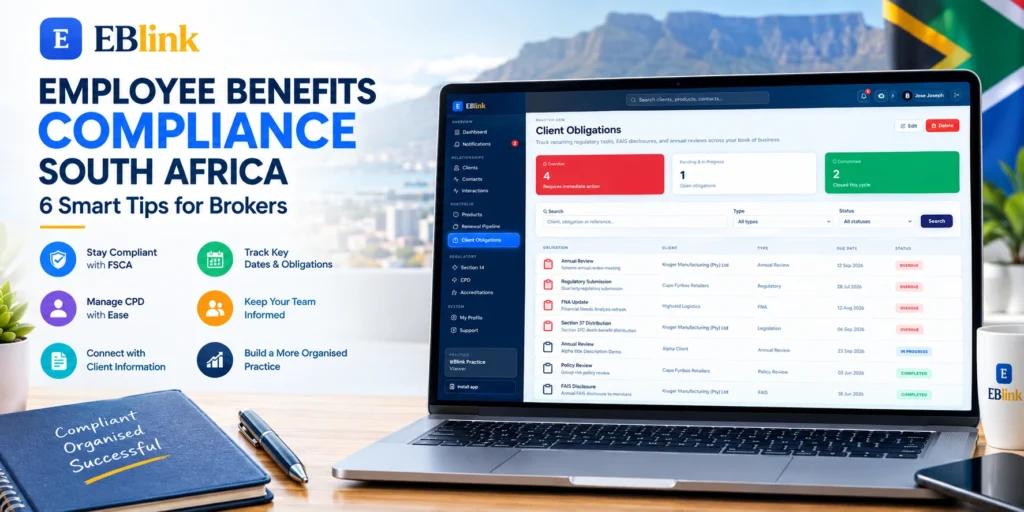
EBlink is designed to bring important parts of an employee benefits brokerage into one central practice environment.
The platform includes dedicated areas for clients, contacts, interactions, products, renewal management and client obligations.
It also includes areas for Section 14, CPD and accreditations.
This allows brokers to manage different parts of their practice from the same environment rather than relying entirely on disconnected spreadsheets and folders.
The EBlink dashboard also provides an overview of areas requiring attention.
This can help brokers see important practice activity without having to search through multiple systems.
For a growing brokerage, having client management, renewal activity and compliance-related information within the same practice environment can make everyday administration easier to organise.
The objective is not to automate every compliance responsibility.
It is to provide a structured place for managing the information and activities that form part of the brokerage’s day-to-day work.
Important Note About Compliance Software
A CRM or practice management platform should not be treated as a replacement for professional compliance advice.
Regulatory requirements can depend on the type of financial services business, licences, representatives, products and other circumstances.
South African brokers and FSPs should continue to follow the requirements that apply to their specific business and seek appropriate professional or compliance advice where necessary.
The FSCA provides official information and services relating to FAIS, fit-and-proper requirements, compliance reporting and regulated entities.
Technology can support organisation and visibility.
It does not transfer regulatory responsibility from the FSP or relevant individuals to the software.
Final Thoughts
Good employee benefits compliance South Africa practices start with organisation.
Important information needs to be accessible.
Dates need to be visible.
Activities need to be tracked.
Teams need to understand what requires attention.
And client, renewal and practice information should be easy to find when it is needed.
For many brokerages, the first step is simply reviewing how much of this information is currently spread across spreadsheets, email inboxes, calendars and folders.
A central CRM can provide a more structured environment for managing these activities.
EBlink brings client management, interactions, products, renewal pipeline, client obligations, Section 14, CPD and accreditations into one practice environment.
For South African employee benefits brokers looking to organise the operational side of their practice, a central system can provide a clearer way to manage information and daily activities.
The technology does not replace professional judgement or regulatory responsibility.
It helps create a more organised foundation for the work around them.
EBlink CRM