

Employee Benefits Renewal Management: 7 Powerful Ways to Stay Ahead. Employee benefits renewal management becomes increasingly important as a brokerage grows. Every renewal can involve client communication, renewal dates, product information, follow-ups, documentation and internal tasks.
When this information is spread across spreadsheets, emails, calendars and personal notes, it can become difficult to see exactly what needs attention.
A structured renewal process can help brokers stay organised, improve visibility and reduce the risk of important follow-ups being missed.
In this article, we explore 7 powerful ways brokers can improve employee benefits renewal management and create a more organised process for managing their book of business.
TABLE OF CONTENTS
- Keep renewal information in one place
- Start preparing before the renewal date
- Use a clear renewal pipeline
- Make follow-ups visible
- Connect renewals with client information
- Give your team better visibility
- Review your process regularly
- How EBlink supports renewal management
- Final thoughts
1. Keep Renewal Information in One Place
Effective employee benefits renewal management starts with knowing where your information is.
A typical renewal may involve client details, scheme information, products, renewal dates, correspondence, meetings, documents and follow-up activities.
If this information is stored across different spreadsheets and folders, your team may spend unnecessary time searching for the latest information.
A central CRM gives brokers a single environment for managing important client and renewal information.
Instead of asking where the latest spreadsheet is, your team can work from a shared system where relevant information is easier to find.
The goal is simple: make important information available when you need it.
2. Start Preparing Before the Renewal Date
Renewals should not become urgent only when the renewal date arrives.
Better employee benefits renewal management starts earlier.
By identifying upcoming renewals in advance, brokers can plan client communication, gather information and allocate work before deadlines become urgent.
A renewal calendar or pipeline can help you identify which clients are approaching renewal and what stage each renewal has reached.
For example, a brokerage might track stages such as:
- Upcoming
- In Progress
- Awaiting Insurer
- Confirmed
- Completed
- Not Renewing
The exact stages will depend on how your brokerage operates.
What matters is having a consistent process that allows your team to understand where every renewal currently stands.
Early visibility gives brokers more time to act instead of reacting when a deadline is already close.
3. Use a Clear Renewal Pipeline
A spreadsheet can show renewal dates, but a renewal pipeline can provide a clearer view of progress.
This is an important part of employee benefits renewal management because a renewal has more information than just a date.
Consider two clients with renewal dates in the same month.
One may already be confirmed while the other is still waiting for information from an insurer or client.
A simple spreadsheet sorted by date may not make this difference immediately obvious.
A structured renewal pipeline can help brokers see:
- Which renewals are approaching
- Which renewals are in progress
- Which renewals are awaiting information
- Which renewals require follow-up
- Which renewals have been confirmed
- Which renewals have been completed
This changes the renewal process from a simple list of dates into a workflow that the team can actively manage.
4. Make Follow-Ups Visible
Follow-ups are a major part of employee benefits renewal management.
A client may need to provide information.
An insurer may need to respond.
A colleague may need to complete a task.
A meeting may need to be scheduled.
When these actions exist only inside personal notes, inboxes or memory, visibility can become a problem.
A CRM can help turn important follow-ups into visible activities connected to the relevant client or renewal.
This becomes especially useful when several people work on the same account.
Instead of relying on one person’s notes, the team can see the information and continue the work from a shared environment.
The objective is not to create more administration.
It is to make the work that already exists easier to see and manage.
5. Connect Renewals With Client Information
A renewal does not exist on its own.
To manage employee benefits renewal management effectively, brokers need access to the relevant client information.
That may include:
- Employer group details
- Client contacts
- Products
- Previous interactions
- Renewal information
- Outstanding activities
- Relevant documentation
Keeping these areas connected makes it easier to move from “This client has a renewal coming up” to “This is everything we need to know about this renewal.”
This is one of the key reasons brokerages use CRM systems.
The CRM becomes a central source of information rather than another separate spreadsheet.
For growing employee benefits practices, centralised information can make daily work easier to organise and easier for team members to follow.
6. Give Your Team Better Visibility
Employee benefits renewal management can become more challenging as a brokerage grows.
One broker may know exactly what is happening with a particular client, while another team member may not have the same information.
This can create unnecessary dependency on individuals.
A shared CRM environment can provide better visibility into client information, interactions and renewal activity.
For example, a team member should be able to identify upcoming work without having to request another person’s spreadsheet or personal notes.
This can be particularly useful when responsibilities change, team members are unavailable or several people support the same client.
Good systems reduce the amount of important information that exists only in someone’s head.
They give the wider team a clearer view of what is happening across the practice.
7. Review Your Process Regularly
Technology is only one part of employee benefits renewal management.
Your actual process matters too.
Take time to review how your brokerage currently manages renewals.
Ask questions such as:
- When do we normally begin preparing for a renewal?
- How do we identify upcoming renewals?
- Where do we record renewal progress?
- How do we track outstanding follow-ups?
- Can another team member understand the status of a renewal?
- What happens when a deadline is approaching?
- Which parts of the process are still handled manually?
These questions can reveal where your existing process works well and where improvements may be useful.
The objective is not to add more administration.
It is to create a repeatable process that makes important work easier to see and manage.
How EBlink Supports Employee Benefits Renewal Management
EBlink is designed to bring important parts of an employee benefits brokerage into one central practice environment.
Instead of managing clients, contacts, interactions, products and renewal activities across disconnected tools, brokers can organise these areas within EBlink.
The platform includes areas for:
- Clients
- Contacts
- Interactions
- Products
- Renewal Pipeline
- Client Obligations
- Section 14
- CPD
- Accreditations
The EBlink dashboard also provides an overview of areas that may require attention, including upcoming renewals and compliance-related items.
For a brokerage managing multiple employer groups, having this information visible in one place can make it easier to understand what is happening across the practice.
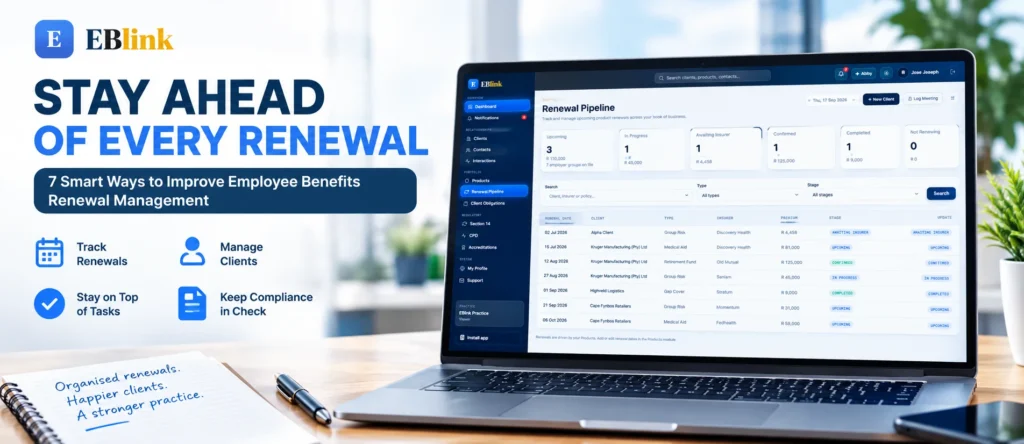
The Renewal Pipeline is particularly useful for employee benefits renewal management because it allows renewal activity to be viewed according to its current stage.
Instead of treating every renewal as simply another date on a spreadsheet, brokers can see whether a renewal is upcoming, in progress, awaiting an insurer, confirmed or completed.
That provides a more structured way to manage renewal activity across the book of business.
Moving From Renewal Spreadsheets to a More Structured Process
Spreadsheets are useful tools, and many brokerages rely on them successfully.
The challenge can arise when a spreadsheet becomes responsible for more and more of the practice.
A spreadsheet may begin by tracking renewal dates.
Over time, it can become a combination of client information, notes, tasks, statuses, reminders and other operational information.
At that point, maintaining the spreadsheet can become a task in itself.
A CRM provides a different approach.
Instead of forcing every part of the process into rows and columns, information can be organised around the way brokers actually work.
Clients can have dedicated records.
Interactions can be recorded.
Products can be managed.
Renewals can move through defined stages.
Client obligations can be monitored.
Compliance-related activities can be organised.
This creates a more structured foundation for employee benefits renewal management as the brokerage grows.
Final Thoughts
Employee benefits renewal management is about more than knowing when a renewal date arrives.
It is about knowing what needs to happen before that date, who is responsible, what information is available and which renewals require attention.
A clear process, consistent follow-ups and centralised information can help brokers manage renewal activity more systematically.
For brokerages that still rely heavily on spreadsheets, email and separate calendars, moving toward a dedicated CRM can be an opportunity to bring these processes together.
EBlink provides a central environment for managing clients, interactions, products, renewals and other areas of the employee benefits practice.
The result is a more connected approach to managing the work behind the book of business.
For more information about EBlink CRM, visit the EBlink website.