

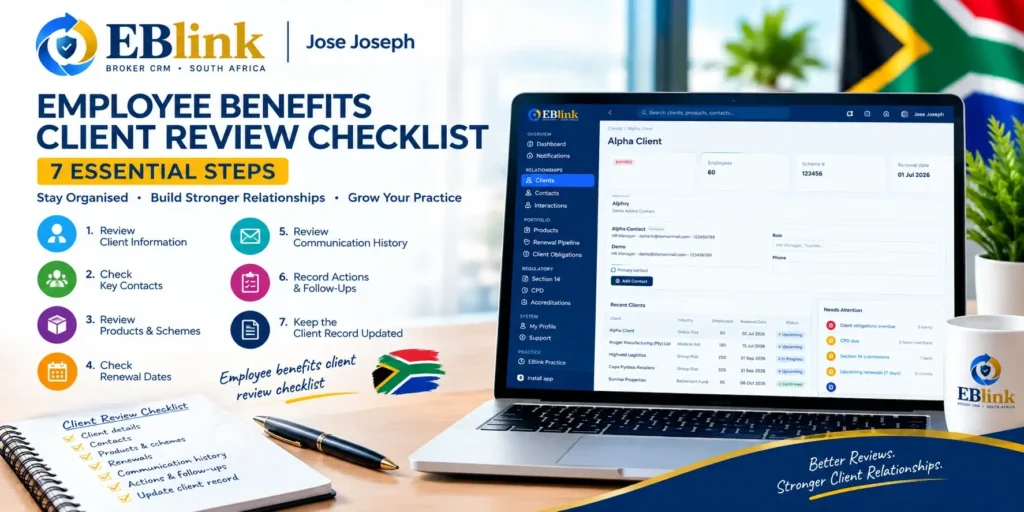
Employee Benefits Client Review Checklist: 7 Essential Steps. A regular client review is an important part of managing an employee benefits relationship. For South African brokers, a structured review can help keep client information current, identify upcoming actions and create a clearer plan for the next stage of the relationship.
Without a consistent process, important details can become scattered across emails, spreadsheets, meeting notes and separate documents.
An employee benefits client review checklist can give brokers a repeatable framework for preparing, conducting and following up on client reviews.
Here are seven practical steps to include in your process.
1. Review the Client Information
Start by checking that the core client information is still accurate.
Review details such as:
- Employer or group name
- Industry
- Number of employees
- Scheme information
- Current client status
- Key notes
- Renewal date
Employee numbers and other client details can change over time, so a client review is a useful opportunity to identify information that needs updating.
A central CRM record can make this process easier because the broker can begin the review from one organised client profile rather than searching through multiple documents.
2. Check Your Key Contacts
People responsible for employee benefits can change roles or leave an organisation.
Before a client review, check whether the recorded contacts are still correct.
Consider reviewing:
- HR contacts
- Finance contacts
- Management contacts
- Trustees or other relevant stakeholders
- Email addresses
- Telephone numbers
- Primary contact status
Keeping contact information current helps ensure that future communication reaches the right people.
It can also make follow-up after the review more efficient.
3. Review Existing Benefit Products
The next step is to review the products and benefit arrangements associated with the client.
Depending on the employer group, this may include areas such as:
- Retirement funds
- Group risk
- Medical aid
- Gap cover
- Other employee benefit arrangements
The purpose is not simply to list the products.
The review should help the broker understand what the client currently has, what may need attention and whether there are upcoming discussions that should be scheduled.
A CRM can help connect client records with product information so that the broker has better context when preparing for a meeting.
4. Check Upcoming Renewal Dates
Renewal planning should form part of the client review process.
Check upcoming renewal dates and identify which clients require preparation or communication.
A useful review process can help answer questions such as:
- Which benefit is approaching renewal?
- When should the client be contacted?
- Has the review meeting been scheduled?
- Are there outstanding actions?
- Is the renewal already in progress?
EBlink CRM includes a Renewal Pipeline that allows brokers to view renewal activity and its current stage.
This can help connect the client review process with the work that needs to happen after the review.
5. Review Previous Communication
Before meeting with a client, review the recent communication history.
Look for:
- Previous emails
- Meeting discussions
- Follow-up requests
- Outstanding questions
- Promises or actions that still need attention
- Important client feedback
This gives the broker context before the meeting and can reduce the need to ask the client for information they have already provided.
A connected interaction history can also help another member of the brokerage understand what has happened previously if they need to assist with the account.
6. Record Actions and Follow-Ups
A client review should result in clear next steps.
During or immediately after the meeting, record the actions that need to be completed.
For example:
- Send updated benefit information
- Request employee data
- Obtain insurer information
- Prepare renewal documentation
- Schedule another meeting
- Follow up with the HR team
- Review a particular benefit
- Investigate a client query
Writing down the next action is useful, but connecting that action to the relevant client relationship is even more valuable.
This helps turn a client review from a meeting into an ongoing workflow.
7. Keep the Client Record Updated
The final step in an effective employee benefits client review checklist is updating the client record.
Any important changes identified during the review should be reflected in the relevant client information.
This may include:
- Updated contact details
- Employee numbers
- Scheme information
- Renewal dates
- Product information
- Notes
- Follow-up activities
- Communication history
The goal is to ensure that the CRM reflects the current client relationship rather than an outdated snapshot.
For South African financial services businesses, maintaining organised information is also relevant to broader regulatory and record-management processes. The Financial Sector Conduct Authority provides regulatory information and online services for financial services providers, including FAIS-related submissions and provider information. FSCA Regulated Entities and Services
Why a Client Review Checklist Helps Brokers
A consistent review process can make client servicing more structured.
Instead of approaching every review differently, brokers can work through the same core areas:
Client information → Contacts → Products → Renewals → Communication → Actions → Updated records
This creates a repeatable workflow that can be used across different employer groups.
It can also make it easier for teams to understand what has been reviewed and what still needs attention.
How EBlink CRM Can Support Client Reviews
EBlink CRM brings several areas of broker practice management together in one platform.
Client records can provide access to core client information and contacts, while products, renewal activity, interactions and client obligations can support the wider servicing workflow.
This means the client review does not have to exist separately from the rest of the brokerage’s work.
The information gathered during a review can become part of the ongoing client record.
For a South African employee benefits broker, that can create a more connected approach to managing employer groups and their benefit arrangements.
Protecting Client Information
Employee benefits practices handle information about clients, contacts and employees, so information management should be considered carefully.
The FSCA provides information relating to POPIA and PAIA, including mechanisms concerning access to and processing of personal information. Brokers should use appropriate internal policies and professional advice to determine the requirements applicable to their own practices. FSCA POPIA and PAIA Resources
A CRM should therefore be used as part of a broader information-management process rather than as a replacement for appropriate governance and security controls.
Final Thoughts
A good employee benefits client review should do more than prepare a broker for a meeting.
It should help create a clear picture of the client relationship, identify upcoming work and establish the actions that need to happen next.
Using an employee benefits client review checklist gives brokers a practical framework for keeping client information, contacts, products, renewals and follow-ups organised.
With the right CRM workflow, the review can become part of a continuous process rather than a once-a-year administrative exercise.
EBlink CRM helps South African brokers connect client information, contacts, products, renewals, interactions and client obligations in one broker-focused platform.