

Employee Benefits Broker Software South Africa: 7 Key Features Brokers Should Look For. Employee benefits broker software South Africa is becoming an important consideration for brokerages that want to organise client information, renewals, compliance activities and everyday practice administration in one place.
As an employee benefits brokerage grows, the amount of information being managed grows with it.
Client records, contacts, products, renewal dates, interactions, obligations and professional development activities can quickly become difficult to manage across spreadsheets, emails and separate systems.
The right software can give brokers a more structured way to manage this information.
But what should a South African employee benefits brokerage actually look for?
In this article, we explore 7 practical features that can help brokers evaluate employee benefits broker software for their practice.
TABLE OF CONTENTS
- Centralised client records
- Renewal management
- Client and team communication
- Compliance and obligations
- CPD and professional development
- Practice visibility
- Simple workflow management
- What to look for when choosing broker software
- How EBlink supports South African brokers
- Final thoughts
1. Centralised Client Records
A strong employee benefits broker software South Africa solution should make client information easy to find.
Employee benefits brokers can manage employer groups, contacts, scheme information, products, renewal dates and other client-related details.
When these records are spread across different spreadsheets and folders, finding the correct information can take unnecessary time.
A central client record gives the brokerage a consistent place to organise important information.
Instead of asking:
“Which spreadsheet has the latest client information?”
your team can work from a central system.
For a growing brokerage, this can also make handovers easier.
If another team member needs to assist with a client, they can start with the client record rather than relying entirely on another person’s personal notes.
2. Renewal Management
Renewals are one of the most important recurring activities in an employee benefits brokerage.
A renewal process can involve client communication, insurer communication, product information, follow-ups, documentation and internal actions.
That means a software system should do more than simply store a renewal date.
It should help brokers understand the status of the renewal.
Useful renewal stages might include:
- Upcoming
- In Progress
- Awaiting Insurer
- Confirmed
- Completed
- Not Renewing
The exact workflow will depend on the brokerage.
The important point is visibility.
A broker should be able to see which renewals are coming up and which ones require attention.
A structured renewal pipeline can help turn renewal management from a spreadsheet exercise into a repeatable workflow.
3. Client and Team Communication
Client relationships generate information every day.
A meeting takes place.
A client sends an email.
A broker makes a follow-up call.
An insurer provides information.
A document is requested.
If these interactions are recorded separately, it can become difficult to understand the full history of a client relationship.
Broker software can provide a central place to record relevant interactions.
This can help create better continuity within the team.
For example, if a colleague needs to assist with a client while the usual broker is unavailable, having the relevant interaction history available can make the handover easier.
The goal is not to record every insignificant conversation.
It is to maintain useful information that helps the team understand the client relationship and what needs to happen next.
4. Compliance and Client Obligations
For South African financial services businesses, compliance and operational responsibilities are important parts of running a practice.
The FSCA’s Fit and Proper framework includes areas such as competence, Continuous Professional Development and operational ability for relevant FSPs, key individuals and representatives.
Broker software can support the administrative side of keeping relevant information organised, but it does not replace professional compliance responsibilities.
A useful system should make obligations and outstanding activities visible.
For example, a brokerage may want to track:
- Annual reviews
- Regulatory submissions
- Client obligations
- Outstanding actions
- Due dates
- Completed activities
- Items requiring follow-up
The benefit is visibility.
Instead of relying entirely on separate reminders and spreadsheets, the brokerage can have a central place to review outstanding work.
5. CPD and Professional Development
Continuous Professional Development is another area South African financial services businesses need to manage appropriately.
The FSCA’s current Fit and Proper information identifies CPD as part of the requirements applicable to relevant FSPs, key individuals and representatives.
For a brokerage, the administrative challenge is keeping professional development information organised.
A software platform can provide a central environment for recording and reviewing CPD-related information.
This can help answer practical questions such as:
- What has been completed?
- What still needs attention?
- Where is the relevant information?
- Which team member is responsible?
Software should support the record-keeping and visibility around these activities.
It should not be presented as a substitute for understanding the regulatory requirements that apply to the business.
6. Practice Visibility
One of the biggest advantages of moving from disconnected spreadsheets to broker software is visibility.
A brokerage owner or manager may want to understand what is happening across the practice without opening several spreadsheets.
A useful dashboard can provide a high-level view of areas such as:
- Active clients
- Upcoming renewals
- Recurring revenue
- Outstanding compliance items
- Renewal stages
- Products
- Work requiring attention
This type of overview can help management identify where attention may be required.
It also reduces the need to manually combine information from different sources to understand what is happening across the book of business.
7. Simple Workflow Management
Good broker software should make daily work easier, not create another complicated administrative process.
This is particularly important for smaller and growing employee benefits brokerages.
If a system requires too many steps for common tasks, adoption can become difficult.
Look for software that makes common activities straightforward.
For example:
- Find a client quickly
- Review client contacts
- Check upcoming renewals
- Record an interaction
- Review outstanding obligations
- Update product information
- Check practice activity
The best workflow will depend on the brokerage.
The key consideration is whether the software fits the way the team actually works.
What to Look For When Choosing Broker Software
Before choosing employee benefits broker software South Africa providers should consider more than the feature list.
Start by looking at the brokerage’s actual workflow.
Ask:
Does the system understand broker workflows?
Generic CRM software can manage contacts and sales opportunities.
But an employee benefits brokerage may need much more than that.
Client records, products, renewals, obligations and practice activities may all need to work together.
Can the team access information easily?
If important information is difficult to find, the software may simply become another system that people avoid using.
Look for clear navigation and practical workflows.
Can the system grow with the brokerage?
A solution that works for a small book should also be able to support a growing client base.
Consider how the system handles additional clients, users, products and workflow activity.
Does it support South African broker requirements?
South African brokerages operate within a specific regulatory and business environment.
The software should therefore be evaluated according to the brokerage’s local requirements rather than simply comparing it with generic international CRM software.
Can it reduce spreadsheet dependency?
The purpose of introducing software should be to improve the workflow.
If the brokerage still needs several spreadsheets to manage the same information, it may be worth examining which parts of the process are not being covered.
How EBlink Supports South African Employee Benefits Brokers
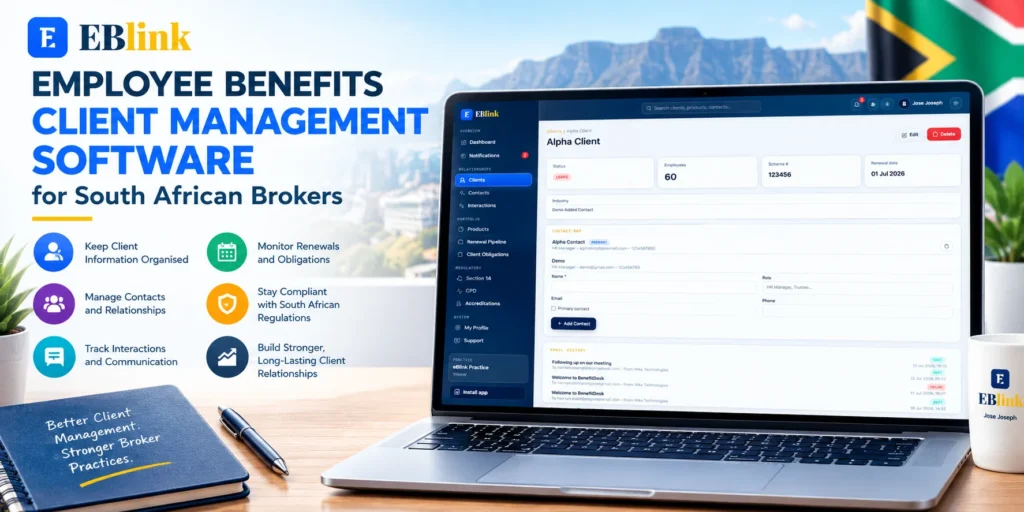
EBlink is designed around the day-to-day requirements of an employee benefits practice.
The platform brings several areas of the brokerage into one central environment.
These include:
- Clients
- Contacts
- Interactions
- Products
- Renewal Pipeline
- Client Obligations
- Section 14
- CPD
- Accreditations
The EBlink dashboard also provides a practice overview showing areas such as active clients, recurring revenue, upcoming renewals and outstanding compliance activity.
The Renewal Pipeline provides a structured view of renewal activity across the book of business.
Client Obligations provides another view of outstanding and completed practice activities.
Together, these features give brokers a central place to manage information that might otherwise be spread across spreadsheets, email and separate reminders.
For South African employee benefits brokers, the objective is straightforward: bring the operational side of the practice into one connected environment.
Moving From Spreadsheets to Broker Software
Many brokerages begin with spreadsheets because they are flexible and familiar.
The problem is not necessarily the spreadsheet itself.
The problem can occur when the spreadsheet becomes responsible for too many different parts of the practice.
Client information may sit in one sheet.
Renewals may sit in another.
Compliance activities may be tracked somewhere else.
Notes may remain in email.
Important reminders may exist in someone’s personal calendar.
As the brokerage grows, this can make the overall process harder to manage.
Moving to broker software can provide a more structured approach.
Instead of building one increasingly complicated spreadsheet, the brokerage can use dedicated areas for clients, products, renewals, interactions and obligations.
That can make information easier to organise and easier for the team to use.
Final Thoughts
Choosing employee benefits broker software South Africa brokerages can rely on is about more than finding a long list of features.
The software should fit the way the brokerage actually works.
Client records should be easy to manage.
Renewals should be visible.
Interactions should be organised.
Outstanding obligations should be easier to track.
Practice activity should be visible to the right people.
And the system should help reduce unnecessary dependence on disconnected spreadsheets.
For South African employee benefits brokers, local workflow and regulatory context also matter.
EBlink brings client management, interactions, products, renewal management, client obligations, Section 14, CPD and accreditations into one practice environment.
The result is a more connected way to manage the operational side of an employee benefits brokerage.
Before choosing any broker software, evaluate your own workflows, information requirements and regulatory responsibilities.
Then choose a system that supports those requirements rather than forcing the brokerage to work around the software.
OUR Social Medias:
Instagram