

FAIS CPD Tracking for Employee Benefits Brokers: 7 Practical Tips. FAIS CPD tracking for employee benefits brokers is an important part of organising professional development records in a South African financial services practice. Brokers need a reliable way to monitor relevant training, maintain supporting evidence and check whether applicable continuing professional development requirements have been met.
When CPD certificates, training records and completion dates are scattered across email inboxes, folders and spreadsheets, it can become difficult to establish what has been completed and which records still need attention.
A structured tracking process helps employee benefits brokers keep their records organised and prepare for internal reviews or regulatory-related checks.
In this guide, we explain seven practical ways to manage CPD records, improve visibility and use broker CRM software to support a more organised practice.
1. Keep CPD Records in One Organised Location
The first step in FAIS CPD tracking for employee benefits brokers is creating a consistent way to record relevant professional development activities.
Depending on the applicable requirements and the individual’s role, records may include:
- Training or learning activity name
- Date completed
- Relevant reporting or CPD period
- Hours or credits, where applicable
- Training provider
- Completion certificate or supporting evidence
- Current record status
- Outstanding administrative actions
Keeping these details organised makes it easier to review an individual’s professional development history.
For South African employee benefits brokerages, a consistent recordkeeping process can also reduce time spent searching for documents when information is needed.
Avoid relying solely on a collection of certificates without a corresponding record of the activities they relate to.
2. Understand the Applicable FAIS CPD Requirements
Not every financial services role has identical professional development requirements. Applicable requirements depend on the person’s regulatory status, role and circumstances.
Before setting up a tracking process, confirm which requirements apply to the relevant financial services provider and individuals.
The Financial Sector Conduct Authority (FSCA) publishes regulatory information and resources at the official FSCA website.
Use official guidance and applicable regulatory requirements when determining relevant periods, qualifying activities, evidence and deadlines.
A tracking spreadsheet or CRM can help organise information, but it should not be treated as a substitute for checking the requirements that actually apply.
3. Monitor CPD Deadlines and Reporting Periods
A recordkeeping process becomes more useful when it helps you identify upcoming deadlines and incomplete activities.
Create a calendar or review schedule aligned with the applicable CPD period. Check progress regularly rather than waiting until the end of the period.
A practical review may include:
- Checking which activities have been completed
- Identifying missing supporting evidence
- Reviewing records that need clarification
- Confirming which activities remain outstanding
- Scheduling appropriate learning activities
- Reviewing completion before the relevant deadline
Set reminders early enough to allow time for completing suitable activities and obtaining supporting documents.
This approach helps brokers identify gaps before they become urgent administrative problems.
4. Record Supporting Evidence Properly
A CPD record is more useful when it can be supported by appropriate evidence.
Depending on the activity and applicable requirements, supporting records may include completion certificates, attendance confirmations or other documentation.
Use a consistent naming and filing convention so that evidence can be located without unnecessary searching.
For example, records could be organised by individual, reporting period and activity type, subject to your firm’s recordkeeping and privacy policies.
Check that the information in the tracking record matches the supporting document. Where a certificate is missing or a detail is unclear, record the issue and assign a follow-up action.
5. Assign Clear Responsibilities for CPD Administration
In a brokerage with several staff members or representatives, CPD administration should have clear ownership.
Individuals may be responsible for completing relevant activities and providing evidence, while an authorised administrator or manager may coordinate recordkeeping and periodic checks.
Define who is responsible for:
- Updating CPD records
- Submitting supporting evidence
- Checking record completeness
- Monitoring upcoming deadlines
- Following up on missing information
- Reviewing records for accuracy
Clear responsibilities reduce the chance that everyone assumes someone else is handling an outstanding task.
Your internal process should also specify who can access sensitive personnel and professional records.
6. Include CPD Tracking in Your Regular Practice Reviews
Do not treat CPD administration as a once-a-year exercise.
Include it in your regular practice management routine. A monthly or otherwise appropriate review can help identify incomplete records, upcoming deadlines and administrative issues that need attention.
Useful review questions include:
- Are the records up to date?
- Is supporting evidence available?
- Are dates and activity details accurate?
- Are outstanding actions assigned?
- Are applicable deadlines approaching?
- Are records accessible to authorised people?
The frequency of review should reflect the size of the practice, the relevant deadlines and the requirements that apply.
Regular checks help make professional development administration a repeatable business process rather than a last-minute scramble.
7. Use a Broker CRM to Improve CPD Visibility
Spreadsheets can be useful for simple recordkeeping, but they may become harder to manage as a brokerage grows.
A broker CRM can help bring professional development tracking into the wider practice management workflow.
When evaluating a system, consider whether it supports:
- Organised CPD records
- Clear activity statuses
- Supporting documentation or references
- Follow-up reminders or task tracking
- Access controls
- A clear view of outstanding administrative actions
The most suitable setup depends on the actual capabilities of the software. Confirm which functions are available before relying on them for a specific regulatory or recordkeeping purpose.
For South African employee benefits brokers, integrating CPD administration into a broader practice workflow may make it easier to review professional development alongside other business responsibilities.
How EBlink Supports CPD Administration for South African Brokers
EBlink is a broker CRM designed for employee benefits brokers in South Africa.
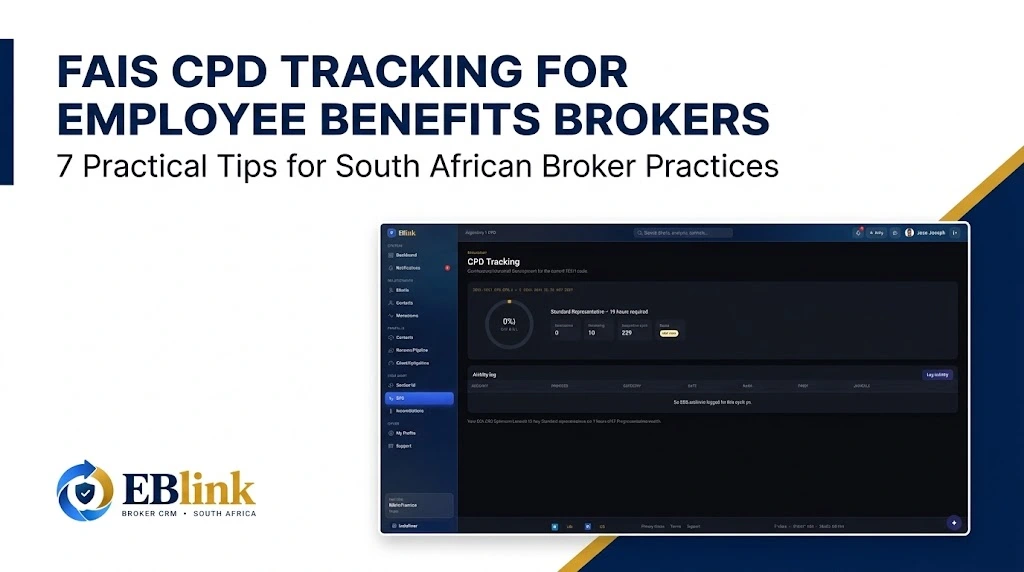
Its platform includes a CPD section, alongside areas for clients, contacts, interactions, products, renewals and client obligations.
This provides brokers with a dedicated place within their broker-focused working environment to organise relevant practice activities. Review the available CPD functionality to confirm how it fits your specific recordkeeping process and requirements.
You can explore EBlink at https://eblink.co.za/.
For additional broker-focused updates, follow EBlink on Instagram and Facebook.
FAIS CPD Tracking Checklist for Employee Benefits Brokers
Use this checklist during your regular administrative review:
- Confirm which CPD requirements apply to each relevant individual.
- Keep a current record of professional development activities.
- Record dates and other required activity details.
- Store supporting evidence in an organised location.
- Monitor applicable reporting periods and deadlines.
- Assign responsibility for outstanding actions.
- Review records for missing or inconsistent information.
- Restrict access to authorised people.
- Check current official regulatory guidance when necessary.
- Review the process regularly and improve it where needed.
Final Thoughts
FAIS CPD tracking for employee benefits brokers is easier to manage when records, supporting evidence, responsibilities and deadlines follow a consistent process.
For South African employee benefits brokerages, organised professional development administration can reduce avoidable searching, improve visibility and help individuals maintain clearer records of their activities.
A dedicated broker CRM may support this process by providing a structured environment for relevant practice information.
If you want to explore a CRM designed for South African employee benefits brokers, visit EBlink to learn more about its features.
Follow us on our social accounts