

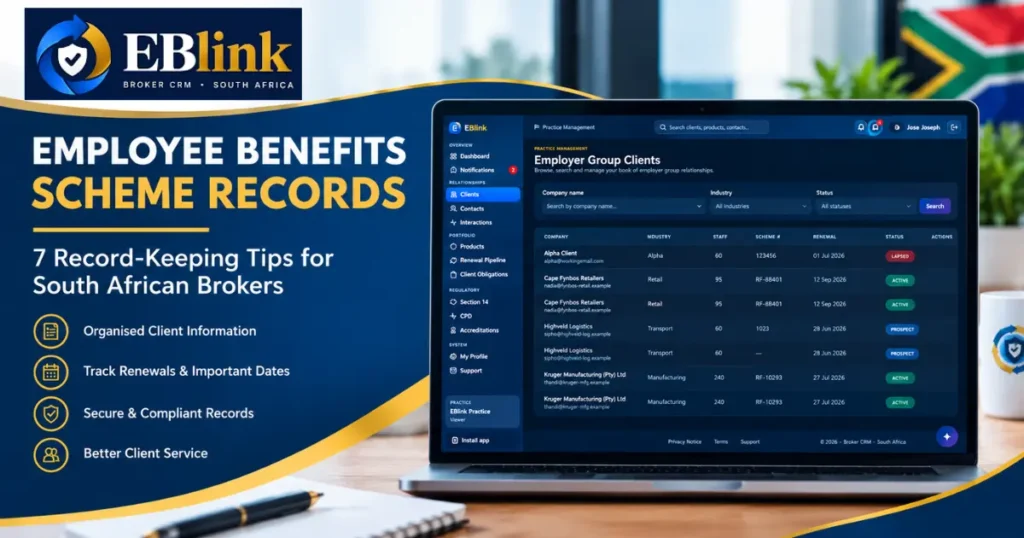
Employee Benefits Scheme Records: 7 Tips for Brokers. Accurate employee benefits scheme records help South African brokers manage employer relationships, prepare for reviews, monitor renewals and respond to client enquiries more efficiently. When important information is outdated or scattered across spreadsheets, emails and documents, routine administration can become unnecessarily difficult.
For employee benefits brokers, maintaining reliable records is about more than keeping contact details up to date. It also means organising relevant scheme information, documenting changes, tracking important dates and ensuring that the right information is available when needed.
Whether you manage a small brokerage or a growing employee benefits practice, a consistent record-keeping process can help improve visibility and support more dependable client service.
In this guide, discover seven practical ways to improve employee benefits scheme records and learn how a broker-focused CRM such as EBlink can support a more organised practice.
Why Are Employee Benefits Scheme Records Important?
Employee benefits brokers work with employers, contacts, insurers, benefit products and ongoing service responsibilities. Accurate records help connect this information and make it easier to understand each employer relationship.
Well-maintained records can help your brokerage:
- Find relevant client information more quickly.
- Prepare for scheduled client reviews.
- Keep renewal dates visible.
- Record important conversations and agreed actions.
- Reduce avoidable administrative errors.
- Improve continuity when colleagues share responsibilities.
Records alone do not guarantee compliance or prevent every mistake. However, consistent processes make it easier to identify missing information and follow up on outstanding tasks.
1. Keep Employer and Contact Details Current
Employer contact details can change when staff members leave, responsibilities move to another department or an organisation restructures.
Outdated contact information can delay important communication, especially when a renewal, scheme review or outstanding document requires attention.
Review the key details held for each employer, including:
- Registered or trading business name, where relevant.
- Main contact person’s name and role.
- Business email address and telephone number.
- Relevant scheme or policy reference.
- Internal relationship owner.
- Date the information was last checked.
Establish a process for updating records when an employer confirms a change. Where several employees interact with the same employer, use a shared source of information rather than maintaining separate, conflicting contact lists.
EBlink includes Clients and Contacts sections to help brokers organise employer and contact information within their CRM workflow.
2. Organise Scheme and Product Information Consistently
Employee benefits practices may deal with several products and arrangements across their client portfolios. If information is recorded differently for every employer, comparing records and locating details becomes harder.
Create a consistent approach to recording relevant scheme and product information. Depending on your brokerage’s responsibilities, this may include product type, insurer or provider, applicable reference numbers, effective dates and the documents associated with an arrangement.
Only store information that is necessary for your business purpose, and ensure access is appropriate for the sensitivity of the records.
Use consistent naming conventions so that colleagues can recognise records without having to guess whether two differently named entries refer to the same employer or arrangement.
A structured CRM can help keep client and product information easier to locate than disconnected spreadsheets and folders.
3. Record Changes and Important Conversations
An accurate record should reflect not only the current position but also relevant changes over time.
For example, an employer might request a review, confirm a contact change or ask for information about an existing benefit arrangement. If the discussion is not documented, another team member may lack the context needed to respond appropriately.
After a meaningful conversation, record:
- The date and people involved.
- The reason for the discussion.
- The relevant information confirmed or changed.
- Any decisions or outstanding questions.
- The next action and responsible person.
Keep notes factual, professional and relevant. Avoid storing unnecessary personal information or sensitive details that do not belong in the record.
EBlink’s Interactions section can support the organisation of client-related activity, helping your team maintain a clearer history of relevant conversations.
4. Check Renewal Dates and Review Information
Renewals and periodic reviews are important parts of employee benefits brokerage work. Missing or inaccurate dates can create avoidable pressure when a client needs attention.
For each relevant arrangement, confirm that renewal and review dates are recorded accurately and updated when changes are confirmed.
Consider reviewing:
- Upcoming renewal dates.
- The current stage of each renewal.
- Outstanding information required from the employer or provider.
- Scheduled client review dates.
- Follow-up actions and their owners.
Review this information regularly rather than waiting until a deadline approaches.
EBlink includes a Renewal Pipeline designed to help brokers track renewal activity. Keeping related client information accurate can make that pipeline more useful for day-to-day practice management.
5. Identify Missing or Outdated Information
A record may exist without containing everything your team needs. For example, an employer’s contact details may be present while a relevant scheme reference, review date or supporting document remains outstanding.
Schedule periodic record checks to identify gaps before they affect routine work.
A practical review can ask:
- Are the employer’s contact details current?
- Are relevant product and scheme references accurate?
- Are important dates recorded?
- Have significant changes been documented?
- Are outstanding actions assigned to someone?
- Are records accessible only to appropriate users?
Assign responsibility for correcting identified gaps and track the action until it is resolved.
The objective is not to collect the maximum amount of information. It is to maintain the accurate, relevant information your brokerage needs to serve clients effectively.
6. Protect Records and Manage Access Responsibly
Employee benefits records may contain confidential business information and, depending on the documents held, personal information about individuals.
South African brokers should consider their applicable obligations under the Protection of Personal Information Act (POPIA), together with any other requirements relevant to their role and arrangements.
Good information-handling practices include:
- Restricting access according to job responsibilities.
- Using appropriate authentication and security controls.
- Avoiding unnecessary duplication of sensitive documents.
- Reviewing how information is shared with colleagues and third parties.
- Following documented retention and secure-disposal procedures.
- Ensuring that staff understand their information-handling responsibilities.
For official guidance, visit the Information Regulator South Africa.
A CRM can help centralise records, but the system alone does not guarantee compliance. Your brokerage still needs suitable procedures, access controls and staff practices.
7. Use a Broker CRM to Maintain Better Records
When employer details, product information, interaction history and renewal dates are spread across different tools, staff may spend too much time searching for information and checking which version is correct.
A broker-focused CRM can help bring relevant information and workflows together.
When evaluating a CRM for your South African employee benefits brokerage, consider whether it supports:
- Employer and contact management.
- Product information organisation.
- Interaction records.
- Renewal pipeline visibility.
- Client obligation tracking.
- Practical access to information needed for ongoing service.
EBlink is designed for employee benefits brokers in South Africa. Its Clients, Contacts, Interactions, Products, Renewal Pipeline and Client Obligations sections support different aspects of organising brokerage information and ongoing practice activity.
You can explore the EBlink CRM application to learn more about the platform.
The aim is to create a reliable working process in which information is easier to find, changes are documented and upcoming responsibilities remain visible.
Build a More Reliable Record-Keeping Process
Accurate employee benefits scheme records help brokers maintain a clearer picture of employer relationships and ongoing responsibilities. Start by checking contact details, standardising scheme information, documenting changes, verifying important dates, identifying missing data and protecting confidential records.
Make record reviews part of your regular workflow rather than an occasional clean-up exercise. Even a short, scheduled review can help your team identify outdated information before it causes unnecessary delays.
If you want to organise employer records, client interactions, renewal activity and obligations in one broker-focused platform, visit EBlink to learn more.
Follow EBlink for more practical guidance for South African employee benefits brokers: