

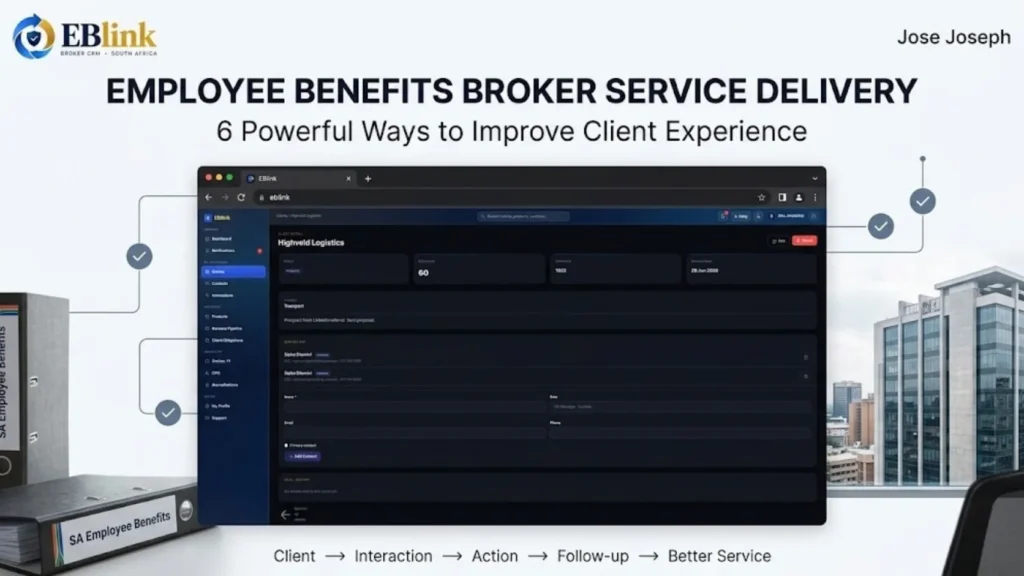
Employee Benefits Broker Service Delivery: 6 Powerful Ways to Improve. For South African employee benefits brokers, delivering a consistently high standard of client service becomes more challenging as an employee benefits practice grows.
A broker may be managing employer groups, medical aid, group risk, retirement funds, disability benefits, renewals, client reviews, compliance requirements and daily client requests at the same time.
When this information is spread across spreadsheets, email inboxes, documents and personal reminders, important follow-ups can become difficult to manage.
That is where a structured approach to employee benefits broker service delivery can make a difference.
A purpose-built employee benefits broker CRM can help bring clients, policies, interactions, renewals and compliance-related activities into one organised system.
For South African brokers, this is particularly valuable because effective service delivery needs to work alongside the regulatory and administrative requirements of the local financial services environment.
Here are six practical ways to improve employee benefits broker service delivery in South Africa.
1. Create One Reliable Record for Every Employer Client
Strong client service starts with reliable information.
An employee benefits broker may need to know an employer’s contacts, benefit arrangements, policies, renewal dates, previous conversations and outstanding actions before responding to a request.
When those details are stored in different spreadsheets and email conversations, finding the correct information can take unnecessary time.
A centralised employee benefits broker CRM can create one structured record for each employer client.
EBlink is designed specifically for South African employee-benefits practices, with employer clients, contacts, policies and engagement history managed within the same environment.
This gives brokers a clearer view of the client relationship and helps reduce dependence on scattered files.
Instead of asking, “Where did we save that information?”, the practice can start with a central client record.
What should a client record contain?
Depending on the practice, this could include:
- Employer and contact details
- Employee or scheme information
- Medical aid arrangements
- Group risk products
- Retirement fund information
- Policy details
- Renewal dates
- Previous interactions
- Client obligations
- Outstanding actions
- Relevant compliance information
The objective is not to collect unnecessary information.
It is to make the information the broker genuinely needs available when it matters.
2. Make Client Follow-Ups Visible
A client request is only useful if it eventually leads to an outcome.
Employee benefits brokers regularly manage tasks that require several follow-ups. An insurer may need to provide information, an employer may need to supply documents, or a broker may need to confirm that a requested change has been completed.
If these activities are managed only through email reminders, important work can become difficult to see.
A stronger employee benefits broker service delivery process makes follow-up work visible.
For example:
Client request → Action assigned → Follow-up → Progress recorded → Action completed
This creates accountability without requiring the broker to remember every outstanding task.
It is particularly useful for growing employee benefits practices where multiple people may be working on the same employer client.
3. Keep Client Interactions Organised
Good client service depends on understanding what has already happened.
Consider an employer who contacts a broker about a benefit change. If the broker can immediately see previous conversations, notes and related actions, the response can be more informed.
Without an organised interaction history, the broker may need to search through old emails or ask the client to repeat information.
That creates friction.
EBlink includes client interactions and messaging functionality as part of its practice workspace, allowing brokers to keep a more structured communication trail.
For a South African employee benefits practice, this can help create continuity when different members of the team assist the same employer.
A useful interaction record can show:
- What the client asked
- When the interaction happened
- Who handled it
- What action was required
- Whether the action was completed
- What needs to happen next
The result is a clearer client history and a more consistent service process.
4. Connect Service Delivery With Compliance
Employee benefits broker service delivery cannot be separated completely from compliance and regulatory administration.
South African employee benefits practices may need to manage activities involving areas such as FAIS, CPD, FICA/CDD, Section 14 and Section 37C, depending on the work and responsibilities of the practice.
The FSCA’s Treating Customers Fairly framework emphasises customer treatment throughout the product lifecycle, including advice and servicing. It also includes an outcome that products should perform as customers have been led to expect and that service should be of an acceptable standard.
This makes organised service processes valuable.
For example, a broker should be able to identify:
- Which client actions are outstanding
- Which compliance-related activities require attention
- Which reviews are due
- Which regulatory deadlines are approaching
- Which client requests have not yet been completed
EBlink’s regulatory functionality includes FAIS, CDD/FICA, Section 14, CPD and Section 37C tracking.
The purpose is not to replace professional judgement.
It is to make important practice activity easier to see and manage.
5. Treat Renewals as Part of Client Service
For employee benefits brokers, renewal management is not simply an administrative deadline.
A renewal can be an important client-service opportunity.
It gives the broker a reason to review the employer’s current arrangements, identify changes, discuss relevant needs and ensure that the renewal process is properly managed.
A strong renewal process should therefore connect the renewal date with the wider client relationship.
A broker might ask:
- When is the client’s renewal due?
- Which products are renewing?
- What stage is the renewal at?
- Has the client been contacted?
- Are insurer responses outstanding?
- Are there issues that need to be resolved?
- Has the renewal outcome been recorded?
EBlink’s renewal pipeline is designed around stages so that brokers can see what is due and where each renewal sits in the process.
This can help turn renewals from isolated calendar dates into part of a structured client-service workflow.
6. Standardise Service Delivery Across the Practice
A growing employee benefits practice can struggle when every person manages clients differently.
One consultant may use spreadsheets.
Another may rely on email flags.
Someone else may keep notes in a personal document.
This may work for a small book, but it becomes harder to manage as the practice grows.
A consistent process gives everyone a common way of handling client activity.
A practical workflow could be:
Client request
Capture the request and identify the client.
Interaction
Record the communication and relevant context.
Action
Identify what needs to happen and who is responsible.
Follow-up
Monitor the outstanding action.
Completion
Record the outcome.
Review
Check whether any further client or compliance action is required.
This approach helps create consistency without forcing every client interaction into an identical script.
The goal is simple: important client work should be captured, visible and followed through.
Employee Benefits Broker Service Delivery and South African Compliance
South African employee benefits brokers operate within a financial services environment where professional advice, customer treatment, regulatory obligations and data management all matter.
The FSCA states that TCF applies across the product lifecycle, from product design and promotion through advice and servicing to complaints and claims handling.
The FSCA also identifies areas such as competence, regulatory examinations, CPD, operational ability and financial soundness within its FAIS Fit and Proper requirements.
For a broker practice, this reinforces the importance of having organised processes rather than relying entirely on memory and disconnected spreadsheets.
A CRM does not replace regulatory responsibility.
Instead, it can provide a structured place for the practice to manage the information and activities that support its day-to-day operations.
Why an Employee Benefits Broker CRM Can Improve Service Delivery
A generic CRM may be designed around sales pipelines and lead generation.
An employee benefits practice has a different operating model.
The broker may need to manage:
- Employer groups
- Employee benefits products
- Medical aid
- Group risk
- Retirement funds
- Renewals
- Client interactions
- Client obligations
- FAIS-related activities
- FICA/CDD information
- Section 14 transfers
- CPD
- Section 37C activities
- Practice reporting
EBlink is built specifically around the workflow of South African employee-benefits practices rather than adapting a generic CRM to the industry.
That distinction matters because service delivery improves when the system reflects the actual work the practice performs.
Signs Your Employee Benefits Service Process Needs Improvement
Your current process may need attention if:
- Client information is spread across several spreadsheets.
- Staff regularly search old emails for client history.
- Follow-ups depend on personal reminders.
- Outstanding client actions are difficult to identify.
- Renewal information is kept separately from client information.
- Compliance dates are tracked manually.
- Different team members use different processes.
- Management cannot easily see which clients need attention.
- Client reviews are difficult to prepare for.
- Important actions are sometimes discovered only after a client follows up.
These problems do not necessarily mean that a broker is providing poor service.
They may simply indicate that the practice has grown beyond a manual administration system.
A South African Employee Benefits Broker Service Checklist
Use this checklist to review your current service delivery process:
- Every employer client has a central record.
- Client contacts are organised.
- Products and policies are recorded.
- Important client interactions are captured.
- Follow-up actions have clear owners.
- Outstanding client obligations are visible.
- Renewal dates and stages are monitored.
- Relevant compliance activities are tracked.
- Completed actions are recorded.
- Team members can access the information they need.
- Management can identify clients requiring attention.
- Sensitive information is handled using appropriate access controls.
A system with these capabilities can help an employee benefits practice move from reactive administration towards a more organised service model.
How EBlink Supports South African Employee Benefits Brokers
EBlink brings the core areas of an employee benefits practice together in one platform.
The system includes employer clients and contacts, policies and products, renewal management, client interactions, messaging, client obligations, revenue information and regulatory functionality.
Its compliance functionality includes areas such as FAIS, CDD/FICA, Section 14, CPD and Section 37C, while role-based access and POPIA-aware data scoping are designed around the South African environment.
That means a broker can build a workflow around the actual needs of an employee benefits practice rather than maintaining separate systems for every part of the book.
Final Thoughts
Effective employee benefits broker service delivery is not about adding more administration.
It is about creating a reliable system for managing the administration that already exists.
For South African employee benefits brokers, that means keeping employer clients organised, recording interactions, tracking follow-ups, managing renewals and maintaining visibility over relevant compliance activities.
When these activities are connected, brokers can spend less time searching for information and more time focusing on clients.
A purpose-built employee benefits broker CRM such as EBlink can help create that structure by bringing clients, policies, renewals, interactions and compliance-related activities into one practice environment.
For a growing South African employee benefits practice, better organisation can become an important part of delivering a more consistent client experience.
EBlink — the CRM for South African employee-benefits brokers.
Connect with us on:
Instagram
Facebook