

Employee Benefits Broker Client Retention: 7 Powerful Strategies Winning a new employer group is only the beginning of a successful employee benefits relationship.
For South African brokers, maintaining strong client relationships over time requires consistent communication, reliable follow-up and a clear understanding of what each client needs.
This is where employee benefits broker client retention becomes important.
Client retention is not simply about keeping a client for another year. It is about creating a servicing experience that gives employers confidence in their broker and makes the relationship valuable throughout the year.
A structured CRM workflow can help brokers stay organised and maintain visibility across the client relationship.
Here are seven practical strategies South African employee benefits brokers can use to strengthen client retention.
1. Know Your Clients Beyond the Renewal Date
A common mistake is to focus heavily on a client only when renewal approaches.
Strong client relationships should be managed throughout the year.
Brokers should have easy access to information such as:
- Employer details
- Employee numbers
- Key contacts
- Products
- Renewal dates
- Previous interactions
- Outstanding activities
- Important client notes
When this information is organised, brokers can prepare for conversations without having to search through multiple systems.
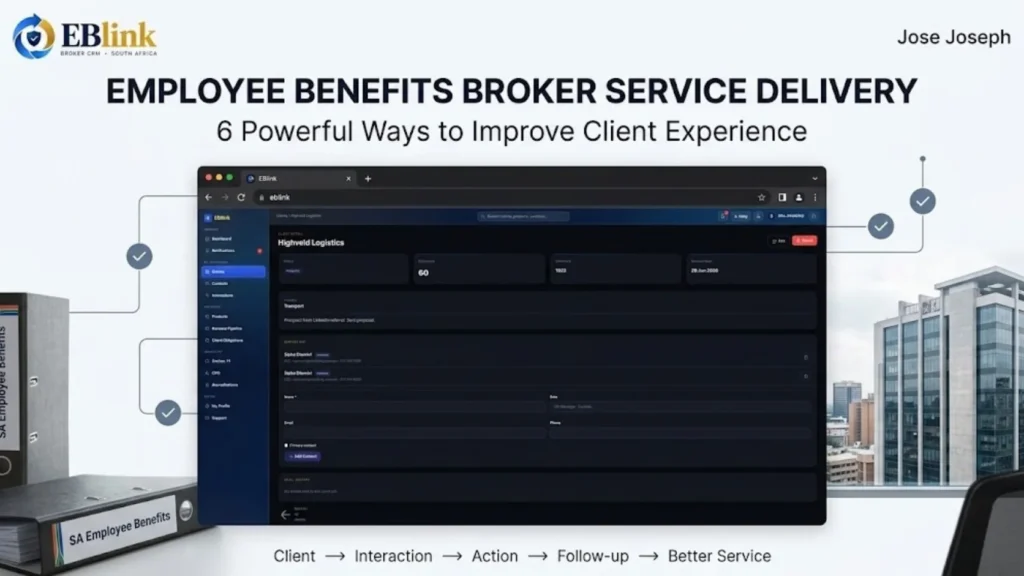
EBlink provides a central client record where important information can be managed as part of the wider practice workflow.
2. Communicate Before Clients Need to Ask
Proactive communication can help create a stronger client experience.
Instead of waiting for an employer to ask about an upcoming renewal, outstanding issue or benefit-related matter, brokers can use their workflow to identify when communication may be appropriate.
For example:
Renewal approaching → Review client → Prepare communication → Contact client → Record interaction
This creates a repeatable process.
It also reduces the risk of important client communication being left until the last minute.
The FSCA’s Treating Customers Fairly approach includes an outcome that customers should be kept appropriately informed before, during and after the point of sale, as well as receiving an acceptable standard of service.
3. Make Client Reviews More Consistent
Regular client reviews can give brokers an opportunity to understand changing needs and identify areas that require attention.
A review might cover:
- Current benefit products
- Employee numbers
- Client objectives
- Recent changes
- Upcoming renewals
- Service issues
- Outstanding actions
- Future requirements
The important point is consistency.
A structured review process means that the broker does not have to reinvent the process for every employer group.
The information gathered during the review can also be recorded in the client’s CRM profile so that it becomes part of the ongoing relationship history.
4. Track Every Important Interaction
A strong relationship depends on context.
If a client called last month about an issue, sent an email last week and has a review scheduled next month, the broker should be able to understand that history.
Interaction tracking can help answer:
- When did we last contact the client?
- What was discussed?
- Was a follow-up promised?
- Who handled the conversation?
- Has the issue been resolved?
- What happens next?
This becomes particularly useful when several people in a brokerage service the same employer.
Instead of relying on one person’s memory or inbox, the team can work from a shared client history.
5. Don’t Let Outstanding Actions Disappear
Client retention can be affected by small things that are left unfinished.
A document that was promised but not sent.
A follow-up that was forgotten.
An information request that has not been answered.
A review that still needs to be scheduled.
These individual items may seem minor, but together they can influence how a client experiences the brokerage.
A structured obligations and task workflow can help brokers identify what remains outstanding.
EBlink’s Client Obligations area provides visibility into overdue, pending and completed client-related activities.
This gives the team a clearer way to monitor work that still requires attention.
6. Use Renewals as a Relationship Opportunity
Renewal discussions are important, but they should not be treated only as an administrative deadline.
A renewal can also be an opportunity to review the relationship and understand whether the client’s circumstances have changed.
The broker can consider:
- Has the workforce changed?
- Have the client’s priorities changed?
- Are existing benefits still appropriate?
- Are there service issues to address?
- Are there upcoming changes that should be discussed?
- Does the client need additional information?
A renewal workflow can help the broker prepare before the conversation takes place.
EBlink’s Renewal Pipeline allows brokers to track renewal activity through different stages, helping the practice maintain visibility over upcoming work.
7. Create a Consistent Client Experience
The final strategy is to make the client experience consistent.
Clients should not have completely different servicing experiences depending on which team member happens to handle their request.
A connected CRM can help create consistency by giving the team access to the same client information and activity history.
That means a team member can understand:
Who the client is → Who the contacts are → What products they have → What happened recently → What is coming next → What still needs attention
This can make the brokerage more organised and reduce unnecessary repetition.
Why Client Retention Matters for South African Brokers
A long-term employee benefits relationship can involve many interactions over several years.
The relationship can change as the employer grows, restructures, changes its workforce or reviews its benefit arrangements.
That means client servicing cannot be treated as a once-a-year exercise.
The FSCA identifies Treating Customers Fairly as an outcomes-based regulatory and supervisory approach and expects regulated entities to demonstrate fair customer outcomes throughout the product life cycle, including advice and servicing.
For brokers, this reinforces the value of having structured processes around communication, servicing and follow-up.
A CRM does not replace professional judgement or regulatory responsibilities, but it can provide the operational structure needed to manage client relationships more consistently.
Signs Your Client Retention Process Needs Improvement
It may be time to review your current process if:
- Client information is spread across several spreadsheets.
- Different team members maintain different records.
- Important follow-ups are tracked in personal inboxes.
- You only review clients when renewal approaches.
- It is difficult to see recent client interactions.
- Outstanding client activities are difficult to identify.
- You spend significant time searching for information before meetings.
These are signs that the problem may not be the amount of information your brokerage has.
The problem may be how that information is organised.
How EBlink Supports Client Retention
EBlink brings key areas of an employee benefits brokerage into one connected environment.
The platform includes:
Clients
Centralise employer information.
Contacts
Keep key stakeholders connected to each client.
Interactions
Maintain visibility into communication and activity.
Products
Keep benefit-related information organised.
Renewal Pipeline
Track upcoming renewals and their progress.
Client Obligations
Monitor outstanding, pending and completed activities.
Dashboard
Review the broader state of the practice.
Together, these areas can support a more consistent client-management workflow.
The objective is not simply to store more information.
It is to make the information useful when the broker needs it.
A Simple Client Retention Workflow
A practical workflow could look like this:
Review the client
Check the latest client information and recent activity.
Identify upcoming needs
Look for renewals, reviews, outstanding actions or other relevant activities.
Contact the client
Communicate proactively rather than waiting for an issue to appear.
Record the interaction
Keep the conversation connected to the client relationship.
Complete the follow-up
Make sure promised actions are tracked through to completion.
Review again
Continue monitoring the relationship throughout the year.
This creates a continuous client-management process rather than a once-a-year renewal process.
Final Thoughts
Effective employee benefits broker client retention is built through consistent service.
It requires brokers to know their clients, communicate proactively, conduct meaningful reviews, track interactions, complete outstanding actions and maintain visibility throughout the relationship.
For South African employee benefits brokers, a connected CRM can make these activities easier to organise.
EBlink brings client information, contacts, interactions, products, renewals and client obligations together in one broker-focused environment.
The goal is simple:
Don’t only manage the renewal. Manage the relationship all year.
Connet with us on social Media