

For South African employee benefits brokers, strong client relationships are built on more than good advice. Employers expect their broker to understand their employee benefits programme, respond quickly, keep important information organised and stay on top of renewals, reviews and regulatory obligations.
That makes employee benefits broker client management an important part of running an efficient and professional brokerage practice.
When client information is spread across spreadsheets, emails, documents and separate systems, it becomes harder to maintain a complete view of each employer. A broker may know the client well but still spend unnecessary time searching for information or checking what needs to happen next.
A centralised broker CRM can help bring these activities together.
1. Keep Every Employer Client Record Organised
The foundation of effective employee benefits broker client management is having a reliable client record.
For each employer, your practice may need to keep track of information such as:
- Client and company details
- Employee numbers
- Scheme information
- Renewal dates
- Industry
- Key contacts
- Products and policies
- Client interactions
- Follow-ups
- Compliance-related activities
When this information is stored in one organised system, brokers can spend less time searching for information and more time servicing clients.
For South African brokers managing multiple employer groups, this becomes increasingly important as the client base grows.
2. Build a Complete View of Each Client
Client management becomes much easier when the broker can see the wider relationship rather than isolated pieces of information.
An employer might have several employee benefit products, multiple contacts and different servicing requirements. Looking at these details separately can make it difficult to understand the full client relationship.
A CRM should provide a central view of the employer relationship.
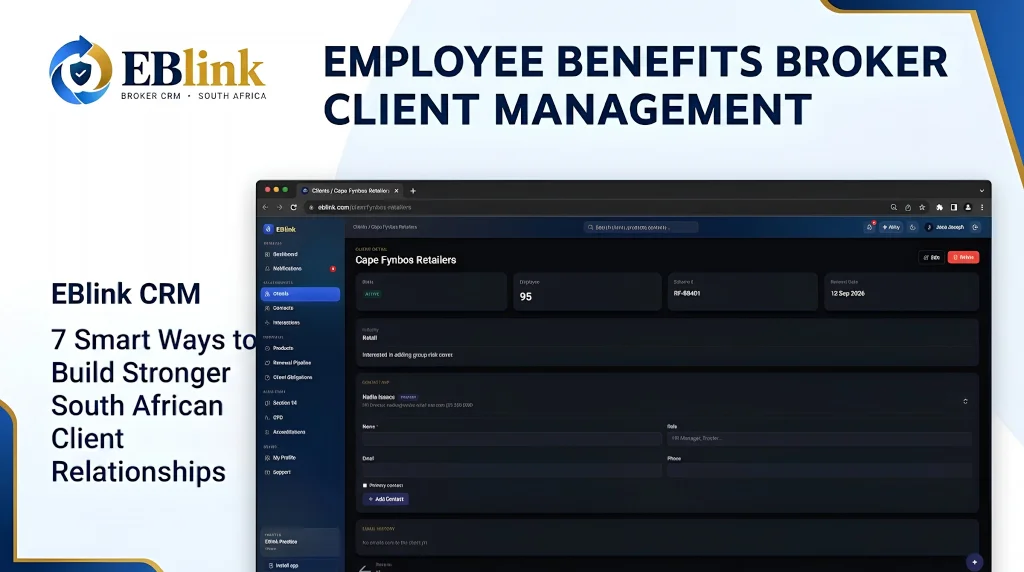
With EBlink, brokers can manage client information alongside contacts, products, interactions and other practice activities.
This creates a more connected view of the client and helps reduce unnecessary duplication.
You can learn more about the platform at https://eblink.co.za/.
3. Track Client Interactions and Follow-Ups
Good client service depends heavily on consistent communication.
A conversation with an HR manager, a follow-up with an employer, a review discussion or an important email can all form part of the client relationship.
Without a structured way to track interactions, important details can easily become difficult to find later.
A broker CRM can help create a more consistent process for recording client interactions and following up on outstanding activities.
This is particularly useful when more than one person in the brokerage works with the same employer.
Instead of relying entirely on individual inboxes or personal notes, the practice can maintain a shared view of the relationship.
4. Stay Ahead of Employee Benefits Renewals
Renewal management is closely connected to client management.
A renewal is not simply an administrative deadline. It is an opportunity to review the employer’s existing employee benefits arrangement, discuss changes and demonstrate ongoing value.
South African employee benefits brokers may be managing renewals across multiple employer groups throughout the year.
A centralised renewal process can help brokers monitor:
- Upcoming renewal dates
- Renewal stages
- Insurer information
- Premium information
- Outstanding actions
- Confirmation and completion
Keeping renewal information visible makes it easier to identify which clients require attention.
5. Make Compliance Part of the Client Workflow
Client management and compliance should not operate as completely separate processes.
Depending on the nature of the business and advice provided, South African financial services practices may need to manage regulatory and administrative responsibilities alongside their client servicing activities.
The Financial Sector Conduct Authority (FSCA) provides regulatory information and resources for financial services providers at https://www.fsca.co.za/.
For brokers, the practical challenge is ensuring that important obligations are not forgotten while managing day-to-day client work.
A structured system can help connect client servicing with activities such as reviews, regulatory submissions, disclosures and other obligations.
The objective is simple: make compliance part of the workflow rather than treating it as an afterthought.
6. Give Clients More Consistent Service
Client experience can suffer when servicing depends too heavily on individual memory.
Two brokers may handle similar employer clients differently if there is no consistent internal process.
A defined client management workflow can help standardise activities such as:
- Client onboarding
- Initial information collection
- Product and policy management
- Regular client reviews
- Renewal preparation
- Follow-ups
- Compliance activities
- Ongoing relationship management
This does not mean every client should receive exactly the same service.
Instead, it gives the brokerage a repeatable foundation that can be adapted to each employer’s needs.
7. Use Practice Visibility to Identify Clients That Need Attention
One of the biggest advantages of a broker CRM is visibility.
Instead of waiting for an email or client complaint to reveal that something has been missed, brokers can use their system to identify activities requiring attention.
For example, a practice may need to identify:
- Upcoming renewals
- Outstanding client actions
- Overdue obligations
- Clients requiring follow-up
- Upcoming reviews
- Incomplete activities
This allows the broker to become more proactive.
For a growing South African employee benefits practice, proactive client management can help improve organisation while creating a more consistent client experience.
What Should South African Brokers Look for in Client Management Software?
When evaluating employee benefits broker software, it is useful to look beyond a basic contact database.
A suitable system should support the actual workflow of an employee benefits brokerage.
Consider whether the platform can help you manage:
- Employer clients
- Contacts
- Employee benefits products
- Renewals
- Client interactions
- Compliance activities
- Practice obligations
- Revenue and business visibility
- Follow-ups and outstanding actions
The closer the software matches the broker’s real workflow, the more useful it becomes.
How EBlink Supports Employee Benefits Broker Client Management
EBlink is designed around the practical needs of employee benefits brokers.
The platform brings together areas such as Clients, Contacts, Interactions, Products, Renewal Pipeline, Client Obligations, Section 14 and CPD.
That means brokers can manage important practice information within a connected system rather than relying entirely on disconnected spreadsheets and documents.
For an overview of EBlink, visit https://eblink.co.za/.
If you would like to follow EBlink’s updates and broker-focused content, you can also connect through Instagram at https://www.instagram.com/josejjoseph80/ and Facebook at https://www.facebook.com/profile.php?id=61593973241760.
Employee Benefits Broker Client Management Checklist
A simple monthly checklist can help keep client management on track:
- Client information is up to date
- Key contacts are recorded
- Products and policies are current
- Recent client interactions are recorded
- Follow-ups have been completed
- Upcoming renewals have been reviewed
- Outstanding obligations have been checked
- Client reviews are scheduled where required
- Important compliance activities are monitored
- Clients requiring attention have been identified
Final Thoughts
Effective employee benefits broker client management is about creating a reliable process for managing employer relationships from onboarding through ongoing servicing and renewal.
For South African brokers, a structured approach can make it easier to manage client information, maintain communication, monitor renewals and keep important practice activities visible.
The right broker CRM can turn client management from a collection of disconnected administrative tasks into a more organised and proactive workflow.
For employee benefits brokers looking to bring client management, renewals, products, interactions and practice obligations together, EBlink provides a dedicated CRM environment built around the broker workflow.
Follow us for more
Facebook