

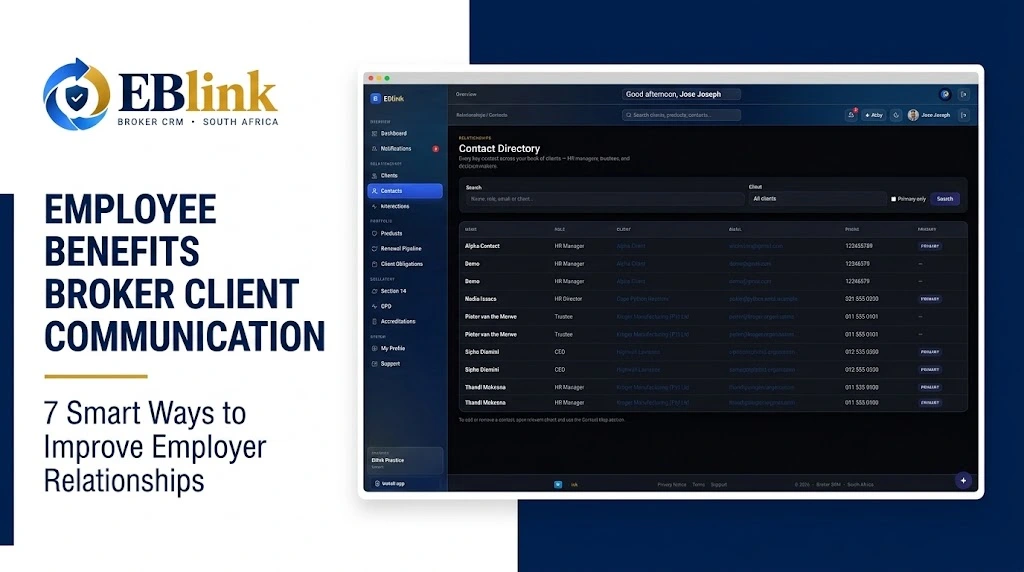
Employee Benefits Broker Client Communication: 7 Tips. Employee benefits broker client communication is essential for South African employee benefits brokers who want to build stronger employer relationships, provide reliable service and manage their brokerage practices efficiently. Employers expect clear updates, timely responses and professional guidance throughout their employee benefits journey.
However, managing communication across emails, spreadsheets, telephone calls and separate documents can make it difficult to keep track of client requests. Important follow-ups may be delayed, renewal updates may be missed, and other team members may struggle to find the latest information.
For South African brokers working with multiple employers, a structured communication process can make a significant difference.
In this guide, discover seven practical ways to improve employee benefits broker client communication, strengthen employer relationships and use broker CRM software to organise client interactions.
1. Keep Employer Contact Information Organised
Accurate contact information is the foundation of effective client communication.
Employee benefits brokers regularly interact with HR managers, finance teams, business owners, trustees and other authorised employer representatives. Each person may have different responsibilities, so knowing whom to contact is important.
Maintain an organised record of:
- Employer names and company details
- Primary and secondary contacts
- Job titles and responsibilities
- Business email addresses and telephone numbers
- Relevant communication preferences
- Important client relationship notes
Review these records regularly, especially when an employer changes staff or responsibilities.
A centralised system helps brokers find contact information quickly instead of searching through different spreadsheets and inboxes.
With EBlink, brokers can organise client and contact information within a broker-focused CRM environment. Visit EBlink’s official website to explore the platform.
2. Establish a Clear Client Communication Process
A consistent communication process helps employers understand what to expect from their broker.
At the beginning of a client relationship, clarify how routine queries, renewal discussions, information requests and follow-ups will be handled.
Your process should identify:
- The appropriate contact for different requests
- Preferred communication channels
- Expected response timeframes
- Who is responsible for outstanding actions
- How important decisions and discussions are recorded
For example, an HR manager may coordinate employee information while another authorised representative approves changes to a benefits arrangement.
Clear responsibilities help prevent confusion and unnecessary delays.
Your communication process should remain flexible enough to accommodate each employer’s needs while maintaining consistent service standards across your practice.
3. Record Important Client Interactions
Effective employee benefits broker client communication requires more than sending emails and making telephone calls. Brokers also need a reliable way to record important discussions and decisions.
Client interactions may include meetings, telephone conversations, email exchanges, review discussions and requests for additional information.
For significant interactions, record:
- The date of the discussion
- The people involved
- The subject discussed
- Important decisions or information confirmed
- Outstanding questions
- The next action and responsible person
These records create continuity throughout the client relationship. If another authorised team member needs to assist the employer, they can refer to the available history instead of relying entirely on someone else’s memory.
EBlink includes an Interactions area to help brokers organise client activity alongside other practice information.
4. Improve Client Follow-Ups and Response Times
Uncompleted follow-ups can undermine an otherwise strong client relationship.
A broker might request information before a renewal, promise to investigate a query or need to follow up with an insurer. Without a structured process, these tasks can become difficult to monitor.
Improve follow-up management with four simple steps:
- Record the action required.
- Assign responsibility to the appropriate person.
- Set a suitable follow-up date.
- Update the record when the action is completed.
Prioritise urgent requests and communicate realistic timeframes to clients. If a response is delayed because you are waiting for information from another party, provide an appropriate update rather than leaving the employer uncertain.
A structured workflow helps your team manage client requests more consistently and identify outstanding work before it becomes a larger problem.
5. Make Renewal Communication Proactive
Renewals are an important part of employee benefits broker client communication in South Africa.
Employers may need to provide information, review existing arrangements, discuss changes or respond to insurer requests before a renewal can progress.
Waiting until the renewal deadline approaches can create unnecessary pressure for everyone involved.
Instead, build communication into your renewal process.
Your workflow may include:
- Reviewing upcoming renewal dates
- Contacting the employer at an appropriate time
- Explaining which information is required
- Recording outstanding employer responses
- Following up with insurers or providers
- Updating the client when meaningful progress occurs
- Recording the final outcome
The appropriate lead time depends on the product, insurer, contractual arrangements and employer requirements.
Using a centralised renewal pipeline alongside client interaction records can help your brokerage coordinate these activities and maintain a clearer view of progress.
6. Protect Client Information and Respect Privacy
Employee benefits brokers may handle personal information, employment-related details and confidential business records. Communication processes should therefore include appropriate privacy and security practices.
South Africa’s Protection of Personal Information Act (POPIA) is relevant to the processing of personal information. Brokers should understand their responsibilities and apply suitable safeguards.
Practical measures include:
- Verifying recipients before sending sensitive information
- Sharing information only with appropriate recipients
- Restricting access to authorised team members
- Avoiding unnecessary personal information in routine messages
- Following internal information-security procedures
- Applying appropriate document-retention practices
For official information, visit the Information Regulator of South Africa.
Financial services providers should also consult the Financial Sector Conduct Authority (FSCA) for relevant regulatory information and guidance.
A CRM can help organise client records, but software alone does not guarantee compliance. Your brokerage must also maintain appropriate policies, training and access controls.
7. Review Your Client Communication Performance
A good communication process should be reviewed regularly to identify areas for improvement.
Instead of measuring success only by the number of emails or calls sent, focus on whether clients receive accurate information, outstanding requests are followed up and important actions are completed.
Consider reviewing these questions each month:
- Are employer contact details up to date?
- Are important interactions recorded?
- Are outstanding follow-ups assigned?
- Are clients receiving appropriate renewal updates?
- Can authorised team members find the latest client information?
- Are unanswered requests being monitored?
- Is confidential information being handled appropriately?
Use the results to improve your workflow, clarify responsibilities and identify recurring service problems.
The objective is to make communication more useful and reliable, not simply to increase the number of messages your team sends.
How EBlink Supports Employee Benefits Broker Client Communication
EBlink is a broker CRM designed for employee benefits brokers in South Africa.
Its workflow includes Clients, Contacts, Interactions, Products, Renewal Pipeline and Client Obligations. These areas help brokers organise important practice information and maintain a more connected view of employer relationships.
By keeping client details and interaction records organised, brokers can reduce their reliance on disconnected spreadsheets and individual notes.
A structured CRM workflow can support better visibility of client activity, renewal-related communication and outstanding practice tasks.
Explore the platform at https://eblink.co.za/.
You can also follow EBlink’s updates and broker-focused content on Instagram and Facebook.
Employee Benefits Broker Client Communication Checklist
Use this checklist to assess your brokerage’s communication process:
- Employer contact information is accurate and current.
- Primary and secondary contacts are recorded.
- Communication expectations are clear.
- Important meetings, calls and emails are documented.
- Follow-ups have assigned responsibilities and dates.
- Renewal-related communication starts at an appropriate time.
- Outstanding client requests are monitored.
- Confidential information is shared appropriately.
- Authorised team members can access relevant records.
- Communication processes are reviewed regularly.
Final Thoughts
Strong employee benefits broker client communication helps South African brokers build better employer relationships, coordinate follow-ups and provide a more consistent service.
Accurate contact records, documented interactions, proactive renewal updates and appropriate privacy practices give your brokerage a practical foundation for managing client relationships.
As your practice grows, a dedicated broker CRM can help keep client information and communication records organised in one connected environment.
If you want to improve your client-management workflow, visit EBlink to learn more about a CRM designed for South African employee benefits brokers.