

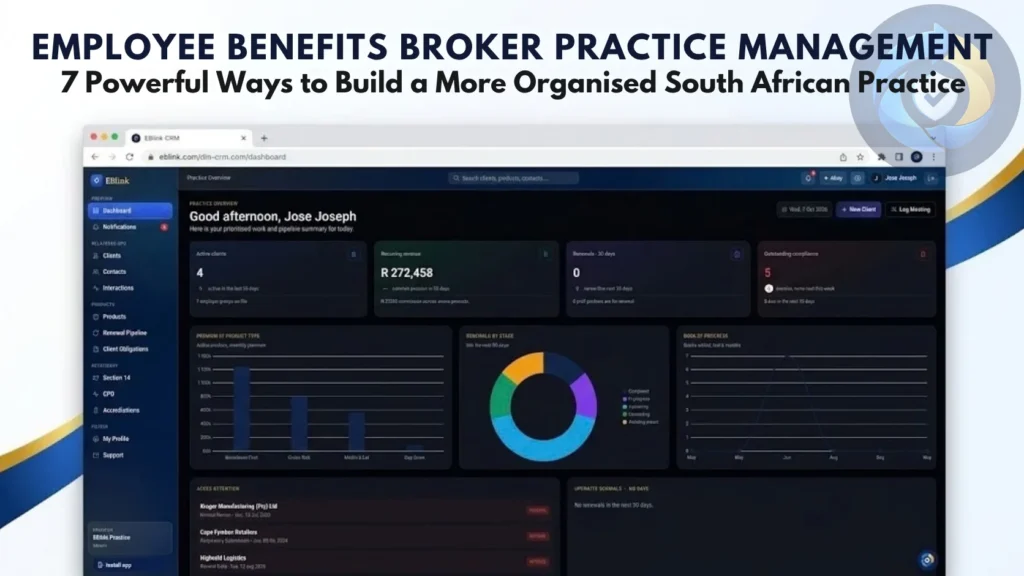
Employee Benefits Broker Practice Management: 7 Powerful Ways to Improve Running a successful employee benefits practice in South Africa involves much more than providing advice to employer clients.
Employee benefits brokers need to manage client relationships, policies, renewals, product information, follow-ups, compliance activities, communications and the financial side of the book. As the practice grows, managing all of this information manually can become increasingly difficult.
That is why effective employee benefits broker practice management matters.
A structured practice management process can help South African employee benefits brokers spend less time searching through spreadsheets, emails and disconnected documents and more time focusing on clients and advice.
A purpose-built broker CRM can support this process by bringing important practice information into one organised system.
EBlink is designed specifically for South African employee-benefits practices, with employer clients, policies, renewals, revenue and compliance managed within one platform.
Here are seven practical ways to improve employee benefits broker practice management in South Africa.
1. Build One Central Record for Every Employer Client
An employer client is rarely just one contact and one policy.
A typical employee benefits relationship may involve several people, multiple products, different renewal dates and ongoing conversations.
For example, an employer group may have:
- Retirement fund arrangements
- Group risk benefits
- Medical aid
- Disability cover
- Gap cover
- Multiple contacts
- Annual review requirements
- Renewal dates
- Regulatory or administrative actions
When this information is kept across different spreadsheets and email folders, it becomes harder to get a complete picture of the relationship.
Good practice management starts with creating one central record for every employer client.
That record should make it easy to understand who the client is, what products they have, who the relevant contacts are, what has happened previously and what needs attention next.
EBlink is built around the employer group as the central client record, with contacts, scheme details, products and engagement history connected to it.
This gives South African employee benefits brokers a more structured way to manage their book of business.
2. Manage Products and Policies in the Same System
Employee benefits practices often manage several types of products across the same employer group.
A broker may have retirement funds, group risk, medical aid or other employee benefit arrangements attached to one client.
If policy information is stored separately from the client record, the broker may have to search several locations to understand the full relationship.
Effective employee benefits broker practice management connects the client to the products and policies associated with them.
Important information can include:
- Product type
- Provider or insurer
- Policy number
- Premium
- Commission
- Status
- Renewal date
- Employer client
EBlink’s product and policy functionality is designed to keep these details connected to the employer group, while allowing brokers to view premium and commission information across the book.
This creates a clearer view of what the practice actually manages.
3. Stop Managing Renewals From Spreadsheets
Renewals are one of the most important recurring activities in an employee benefits practice.
A missed renewal date can create unnecessary pressure for the broker and employer client.
Yet many practices still depend on spreadsheets, calendar reminders or individual email folders to keep track of upcoming renewals.
A stronger practice management process puts renewals into a dedicated workflow.
For every renewal, the broker should be able to see:
- The employer client
- Product type
- Renewal date
- Insurer or provider
- Current stage
- Premium
- Next action
- Final outcome
EBlink provides a renewal pipeline with stages that allow brokers to see what is upcoming, what is in progress, what has been confirmed and what is not renewing.
This gives a South African employee benefits practice a forward-looking view of its renewal workload.
Instead of asking, “Which renewals are coming up?”, the practice can start the day with a clearer view of what requires attention.
4. Make Compliance Part of Daily Practice Management
Compliance should not be treated as something that only receives attention when a deadline is approaching.
Depending on the practice and its responsibilities, South African employee benefits brokers may need to manage activities involving areas such as FAIS, CDD/FICA, Section 14, CPD and Section 37C.
The FSCA’s current FAIS Fit and Proper framework includes areas such as competence, regulatory examinations, CPD, operational ability and financial soundness for the relevant regulated persons and entities.
The practical challenge for a broker is keeping the relevant information and dates organised throughout the year.
That is where practice management becomes important.
Instead of maintaining separate compliance spreadsheets, brokers can build compliance activities into their overall practice workflow.
For example:
Client → Obligation → Due date → Responsible person → Status → Completion
EBlink includes regulatory tracking for areas such as FAIS, CDD/FICA, Section 14 and CPD, with Section 37C also included in its practice functionality.
A structured system does not replace the broker’s regulatory responsibilities or professional judgement. It can, however, make relevant activities easier to see and manage.
5. Keep a Clear History of Client Interactions
Client communication is another important part of employee benefits broker practice management.
An employer may call about a benefit change today, discuss a renewal next month and request documentation several weeks later.
Without a reliable communication history, it can become difficult to understand what has already happened.
A structured interaction history can help brokers see:
- Previous calls
- Emails
- Meetings
- Notes
- Review discussions
- Follow-up actions
- Communications sent to the client
EBlink provides client interaction and messaging functionality, including meeting templates and a communications trail associated with the client.
This can help create continuity when more than one consultant or team member works with the same employer group.
It also means the practice is less dependent on one person’s inbox or personal notes.
6. Give the Practice Better Visibility Over Revenue
Practice management is not only about administration.
A broker also needs to understand the commercial performance of the book.
Important questions include:
- What recurring premium is currently on the book?
- Which products generate revenue?
- What commission is being earned?
- Which clients and products contribute to the practice?
- What could be affected by upcoming renewals?
When revenue information is disconnected from client and policy information, it becomes harder to understand the commercial side of the practice.
EBlink connects recurring premium and commission information to the wider book of business, with role-based access to revenue information.
This gives principals and authorised users a clearer view of the commercial side of the employee benefits practice without making revenue information available to everyone by default.
7. Create One Consistent Practice Workflow
The final step is perhaps the most important.
Technology alone does not create good practice management.
The practice also needs a consistent way of working.
A simple workflow might look like this:
Client → Product → Interaction → Action → Renewal/Review → Compliance → Completion
This means important work follows a repeatable process rather than depending on memory.
For example, when a client requests a change, the team should know:
- Where the request is recorded.
- Who is responsible.
- What action is required.
- When it needs to be completed.
- How the outcome is recorded.
- Whether any follow-up is still required.
This becomes increasingly important as an employee benefits practice grows and more consultants, administrators or support staff become involved.
A common system creates a common process.
What South African Employee Benefits Brokers Should Look for in Practice Management Software
Not every CRM is designed for an employee benefits practice.
A general sales CRM may focus heavily on leads, opportunities and sales activities.
An employee benefits broker needs a system that reflects the actual shape of the practice.
Before choosing practice management software, consider whether it can manage:
- Employer clients
- Contacts
- Employee benefit products
- Policies
- Renewals
- Client interactions
- Client obligations
- Compliance activities
- Revenue and commission
- Reporting
- Team roles
- Data access
EBlink’s platform is specifically designed around South African employee-benefits practices rather than adapting a generic CRM to the industry.
Practice Management and Treating Customers Fairly
Practice management also connects with the quality of client servicing.
The FSCA describes Treating Customers Fairly (TCF) as an outcomes-based regulatory and supervisory approach. The FSCA says the relevant fairness outcomes apply throughout the product lifecycle, including advice and servicing.
For an employee benefits practice, organised client information and service processes can help support consistent communication and follow-up.
This is not about using software to “tick a compliance box”.
It is about creating a practice where important client activity is visible, documented and easier to manage.
A Simple Employee Benefits Broker Practice Management Checklist
Use this checklist to review your current practice:
- Every employer client has a central record.
- Client contacts are organised.
- Products and policies are linked to the correct employer.
- Renewal dates are tracked.
- Renewal stages are visible.
- Client interactions are recorded.
- Outstanding actions are clearly identified.
- Relevant compliance dates are monitored.
- Revenue and commission information is accessible to authorised users.
- Team members know who is responsible for each action.
- Completed activities are recorded.
- Client information is managed with appropriate access controls.
If several of these activities are still being managed through separate spreadsheets and personal reminders, it may be time to review the practice’s systems.
Why a Purpose-Built Broker CRM Can Help
The objective of practice management is not to create more administration.
It is to make existing administration easier to control.
For South African employee benefits brokers, having clients, products, renewals, interactions, compliance and revenue connected in one system can create a much clearer view of the practice.
EBlink was built specifically for this environment. Its platform brings relationships, portfolio information and South African regulatory work together under one login.
That can help brokers move from:
Spreadsheets + inboxes + reminders
to:
One system + structured workflows + clearer visibility
Final Thoughts
Effective employee benefits broker practice management is about creating a reliable system for running the day-to-day operation of an employee benefits practice.
For South African brokers, that means managing employer clients, products, renewals, interactions, compliance activities and revenue in a structured way.
As a practice grows, relying entirely on spreadsheets, emails and memory becomes increasingly difficult.
A purpose-built broker CRM can help bring those moving parts together.
EBlink is built specifically for South African employee-benefits brokers, helping practices manage clients, policies, renewals, compliance and the wider book of business in one place.
If your practice is still being managed across multiple spreadsheets and inboxes, the first step may simply be to ask:
Can I see everything my practice needs to manage from one place?
If the answer is no, it may be time to rethink your practice management system.
EBlink — the CRM for South African employee-benefits brokers.
Follow Jose Joseph for more employee-benefits practice and broker insights on Instagram.
You can also follow Jose Joseph on Facebook for more EBlink and employee-benefits broker updates.