

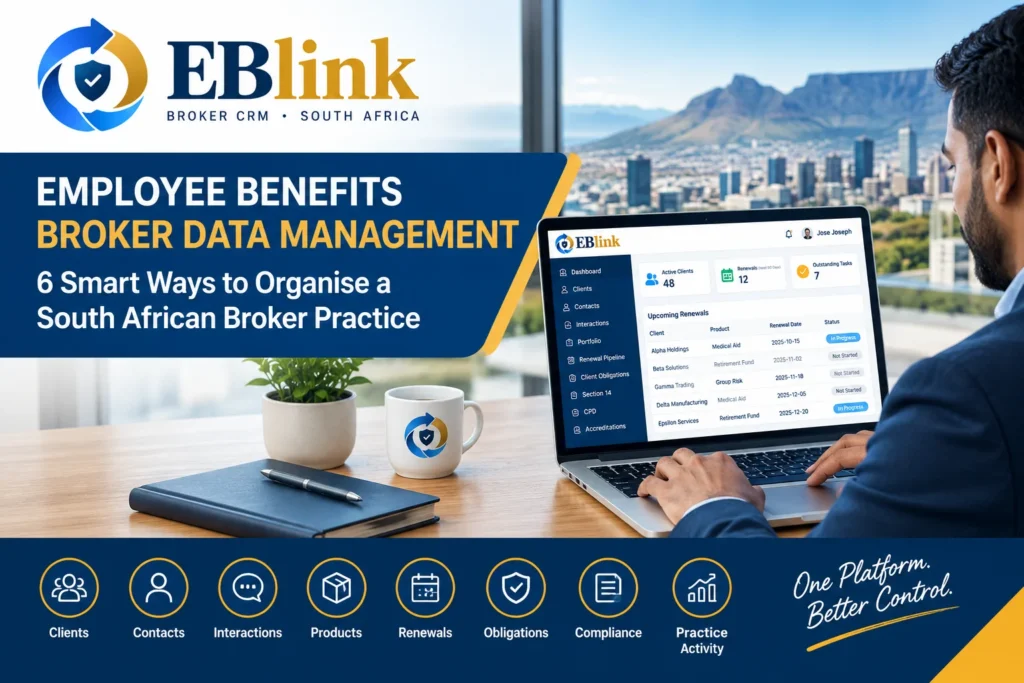
Employee Benefits Broker Data Management: 6 Smart Ways to Stay Organised. Employee benefits brokerages manage a large amount of information every day.
Client details, employee numbers, scheme information, contacts, products, renewal dates, interactions and practice activities all need to be recorded and maintained.
When this information is spread across spreadsheets, emails and separate documents, it can become difficult to know which information is current and where to find it.
This is why employee benefits broker data management is an important part of running an organised brokerage.
For South African employee benefits brokers, having a structured approach to managing information can help create better visibility across the practice.
Here are six practical ways to keep broker data more organised.
1. Create One Reliable Client Record
The foundation of effective employee benefits broker data management is having a reliable client record.
A client profile may need to contain information such as:
- Employer name
- Industry
- Number of employees
- Scheme information
- Renewal date
- Client status
- Key contacts
- Products
- Important notes
If this information exists in several spreadsheets, the team may spend unnecessary time checking which version is correct.
A central CRM record gives the brokerage one place to maintain the information.
With EBlink, brokers can organise important client information within the client record and access it when managing the relationship.
2. Keep Contacts Connected to Clients
Client information and contact information should not be treated as completely separate records.
An employer group may have several relevant contacts, including HR, finance, management or other stakeholders.
When contacts are connected to the correct client, the broker can understand the relationship more easily.
A structured contact record can include:
- Name
- Role
- Email address
- Telephone number
- Relationship to the client
- Primary contact status
This can make communication more efficient and reduce the need to search through old emails for basic contact information.
3. Organise Product Information
Employee benefits practices may manage multiple products for each employer group.
The information associated with those products can include benefit types, insurers, premiums and other relevant details.
Keeping product information connected to the client creates a more complete view of the relationship.
For example, when preparing for a client discussion, the broker may want to understand which products are currently associated with the employer before discussing future requirements.
This is easier when product information is organised within the same practice-management environment.
4. Keep Renewal Information Accurate
Renewal dates are another important part of employee benefits broker data management.
A renewal date that is incorrect, outdated or difficult to find can affect planning and follow-up.
For this reason, renewal information should be maintained as part of the wider client record.
A dedicated renewal workflow can also provide greater visibility across the book.
EBlink includes a Renewal Pipeline that allows brokers to view renewal information and track different stages of the renewal process.
This connects renewal data with the broader client relationship rather than leaving it isolated in a spreadsheet.
5. Connect Information With Practice Activity
Data becomes more useful when it can be connected to the activity surrounding it.
A client record can be linked with:
Contacts → Interactions → Products → Renewals → Obligations
This gives brokers more context.
For example, a broker preparing for a client meeting may want to see who the key contacts are, what products the employer has, whether a renewal is approaching and whether there are outstanding obligations.
Having these areas connected can reduce the amount of manual searching required.
It also makes it easier for another team member to understand the client relationship if they need to assist.
6. Use a Dashboard for Practice Visibility
Good employee benefits broker data management should ultimately help the brokerage understand what is happening across the practice.
A dashboard can turn individual pieces of information into a broader practice view.
For example, EBlink’s dashboard can provide visibility into areas such as:
- Active clients
- Recurring revenue
- Upcoming renewals
- Outstanding compliance-related activity
- Products
- Renewal stages
- Practice activity
This means brokers do not have to rely entirely on manually combining information from different spreadsheets.
Instead, the dashboard provides a starting point for reviewing the overall state of the practice.
Why Data Organisation Matters for South African Brokers
Data management is not simply an administrative exercise.
Employee benefits brokers handle information relating to businesses, contacts and employees, so responsible information management is an important consideration.
South Africa’s Information Regulator explains that POPIA establishes conditions for the lawful processing of personal information by public and private bodies.
Brokers should therefore consider their own policies, access controls, security practices and legal obligations when deciding how client information should be managed.
A CRM can provide an organised environment for managing information, but it does not replace the brokerage’s responsibility to understand and comply with applicable requirements.
Avoiding the Spreadsheet Data Problem
Spreadsheets can be useful tools.
The challenge begins when a brokerage uses multiple spreadsheets as the primary system for managing an entire client book.
One spreadsheet might contain client information.
Another might contain renewals.
Another might contain contacts.
A separate document might contain compliance-related activities.
And important client communication may remain inside individual email inboxes.
This can create duplicated information and make it harder to maintain consistency.
A CRM provides a different approach by connecting these areas within one system.
The objective is not simply to eliminate spreadsheets.
It is to create a central source of information for the workflows that are most important to the brokerage.
What Good Broker Data Management Looks Like
A practical data-management process should make it easy to answer questions such as:
Who is this client?
The client record should provide the relevant employer information.
Who are the key contacts?
The contact information should be connected to the client.
What products does the client have?
Product information should be accessible from the practice environment.
When is the next renewal?
Renewal information should be visible and maintained.
What happened recently?
Relevant interactions should be recorded.
What still needs attention?
Outstanding obligations and activities should be visible.
When these questions can be answered from one connected system, the brokerage has a much clearer operational picture.
How EBlink Supports Broker Data Management
EBlink brings several areas of an employee benefits practice into one environment.
The platform includes areas for:
- Clients
- Contacts
- Interactions
- Products
- Renewal Pipeline
- Client Obligations
- Section 14
- CPD
- Accreditations
This allows brokers to manage different types of practice information without treating every process as a separate system.
The client record provides the starting point, while other areas add context around the relationship.
For a South African employee benefits practice, this can create a more connected approach to managing information.
Building a More Organised Practice
Improving employee benefits broker data management does not necessarily mean changing everything at once.
A brokerage can start with the information it uses most frequently.
For example:
- Standardise client records.
- Clean up contact information.
- Connect products to clients.
- Maintain accurate renewal dates.
- Record important interactions.
- Review outstanding obligations.
- Use the dashboard to monitor practice activity.
Over time, these steps can create a more consistent information-management process.
Final Thoughts
Employee benefits brokerages depend on accurate and accessible information.
When client data, contacts, products, renewals and practice activities are scattered across different systems, managing the brokerage can become unnecessarily complicated.
A structured approach to employee benefits broker data management can help create a clearer and more connected workflow.
For South African brokers, this also means considering appropriate information-management and privacy responsibilities alongside the operational benefits of using a CRM.
EBlink brings client records, contacts, interactions, products, renewals and obligations into one broker-focused environment.
The goal is simple: organise the information behind the practice so brokers can spend more time using it and less time searching for it.