

Employee Benefits Broker: 7 Powerful Practice Management Tips Managing an employee benefits practice involves much more than advising clients and comparing products.
For brokers in South Africa, keeping client information organised, monitoring renewals, following up on obligations and maintaining a clear view of daily priorities can quickly become difficult when information is spread across spreadsheets, emails and separate systems.
This is where employee benefits practice management becomes important.
A structured practice management approach can help brokers bring client relationships, renewals, products, compliance-related tasks and day-to-day activity into one organised workflow.
What Is Employee Benefits Practice Management?
Employee benefits practice management is the process of organising the information, activities and workflows that keep an employee benefits brokerage operating efficiently.
Instead of relying on disconnected spreadsheets and manual reminders, brokers can create a more structured system for managing:
- Employer clients
- Contacts and relationships
- Employee benefit products
- Renewal dates
- Client obligations
- Regulatory-related tasks
- Practice activity
- Follow-ups
- Business pipeline
For a growing South African brokerage, having this information available in one place can make everyday work easier to manage.
1. Keep Client Information in One Place
The first step in effective employee benefits practice management is having a reliable record of every client relationship.
Important information can include:
- Employer name
- Industry
- Number of employees
- Scheme information
- Renewal dates
- Key contacts
- Client status
- Products
- Previous interactions
When this information is spread across different spreadsheets and email threads, finding the right information can take unnecessary time.
A CRM such as EBlink provides a central place to manage employer group relationships and client information.
This gives brokers a clearer view of the client before a meeting, renewal discussion or follow-up.
2. Make Renewals Easier to Track
Renewals are an important part of an employee benefits brokerage.
A renewal workflow can involve multiple dates, products, insurers, client discussions and stages.
Without a structured process, it can become difficult to see which renewals are upcoming, which are already in progress and which still require attention.
A renewal pipeline can provide a visual overview of these activities.
With EBlink, brokers can use the Renewal Pipeline to view renewal dates and stages across their book of business.
This makes it easier to identify upcoming work and keep renewal activity visible.
3. Create a Clear View of Practice Priorities
Another important part of employee benefits practice management is knowing what needs attention today.
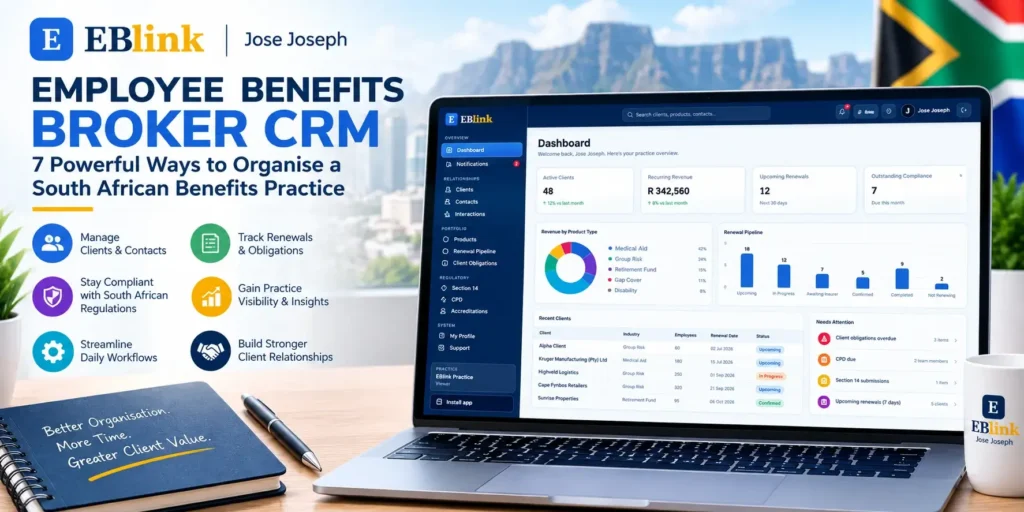
A dashboard can bring important information together instead of requiring brokers to check multiple spreadsheets or systems.
For example, a practice dashboard can provide visibility into:
- Active clients
- Recurring revenue
- Upcoming renewals
- Outstanding items
- Product activity
- Renewal stages
- Recent client activity
This type of overview can help brokers start the day with a clearer understanding of their current workload.
Rather than searching through different files, the broker can begin with the areas that require attention.
4. Organise Client Obligations
Employee benefits brokers also have ongoing administrative and regulatory-related responsibilities.
These activities can include annual reviews, regulatory submissions, disclosures and other client obligations.
Keeping these activities in separate spreadsheets can make it harder to maintain a consistent workflow.
EBlink includes a Client Obligations area designed to give brokers a central view of outstanding, pending and completed obligations.
A structured obligations workflow can help make important tasks visible instead of relying entirely on memory or scattered reminders.
5. Keep Client Contacts Connected to the Relationship
An employer relationship may involve several people.
There may be an HR manager, trustee, finance contact or another person involved in the benefits relationship.
Keeping those contacts connected to the correct employer record makes the client relationship easier to understand.
A CRM can help brokers maintain contact information alongside the client record.
This means the broker can quickly see who is associated with a client instead of searching through old emails or separate contact lists.
For relationship-driven businesses, this can be a valuable part of employee benefits practice management.
6. Use Practice Data to Understand the Business
A CRM is not only about storing information.
The information inside the system can also provide a broader view of the brokerage.
For example, a dashboard can help brokers see trends and activity across areas such as:
- Product types
- Revenue
- Renewals
- Client growth
- Outstanding work
- Recent activity
This can help turn day-to-day client information into a clearer practice overview.
Instead of looking at each client separately, brokers can also step back and understand what is happening across their book of business.
7. Replace Scattered Processes With One Workflow
Perhaps the biggest benefit of structured employee benefits practice management is reducing the number of disconnected processes.
A typical brokerage may use:
- Spreadsheets for client information
- Calendars for reminders
- Email for client communication
- Separate documents for obligations
- Different files for renewal tracking
Each tool may work on its own, but the overall process can become difficult to manage.
A CRM brings these workflows closer together.
With EBlink, brokers can move between clients, contacts, interactions, products, renewals and client obligations from one practice-management environment.
That creates a more connected workflow for the brokerage.
Why Practice Management Matters for South African Brokers
South African employee benefits brokers operate in a market where client relationships, administration and regulatory responsibilities all need careful attention.
The Financial Sector Conduct Authority (FSCA) provides regulatory information and resources relevant to financial services businesses in South Africa, making it important for firms to maintain appropriate processes and records.
A CRM does not replace professional judgement, regulatory guidance or the broker’s own compliance responsibilities.
Instead, technology can help organise the information and workflows that support the practice.
For a growing brokerage, that distinction is important: the CRM is a management tool, while professional and regulatory responsibilities remain with the relevant people and business.
How EBlink Supports Employee Benefits Practice Management
EBlink brings several core brokerage workflows together in one platform.
Brokers can manage:
Clients
Keep employer group information organised and accessible.
Contacts
Connect key people to the appropriate client relationship.
Interactions
Keep track of activity and client-related interactions.
Products
Maintain visibility across products within the practice.
Renewal Pipeline
Track upcoming renewals and their current stages.
Client Obligations
Monitor outstanding, pending and completed obligations.
Section 14 and CPD
Access dedicated areas within the practice environment for relevant workflows.
Together, these features provide a more structured approach to employee benefits practice management.
From Spreadsheets to a More Connected Practice
A spreadsheet can be useful for simple tracking.
But as a brokerage grows, the amount of information being managed can grow with it.
More clients mean more contacts.
More products mean more renewal activity.
More clients also mean more follow-ups, obligations and administrative tasks.
At that point, having a central CRM can provide a more connected way to manage the practice.
The goal is not simply to replace a spreadsheet.
The goal is to create a clearer workflow where client information, renewals, obligations and practice activity can be managed together.
Final Thoughts
Effective employee benefits practice management starts with organisation.
When brokers can quickly find client information, see upcoming renewals, monitor obligations and understand their overall practice activity, everyday management becomes more structured.
For South African employee benefits brokers looking to move away from disconnected spreadsheets and manual processes, a dedicated CRM can provide a central environment for managing the practice.
EBlink is designed around these brokerage workflows, helping bring clients, contacts, interactions, products, renewals and obligations together in one place.
A more organised practice can give brokers more visibility into their work — and more time to focus on their clients.